Introduction
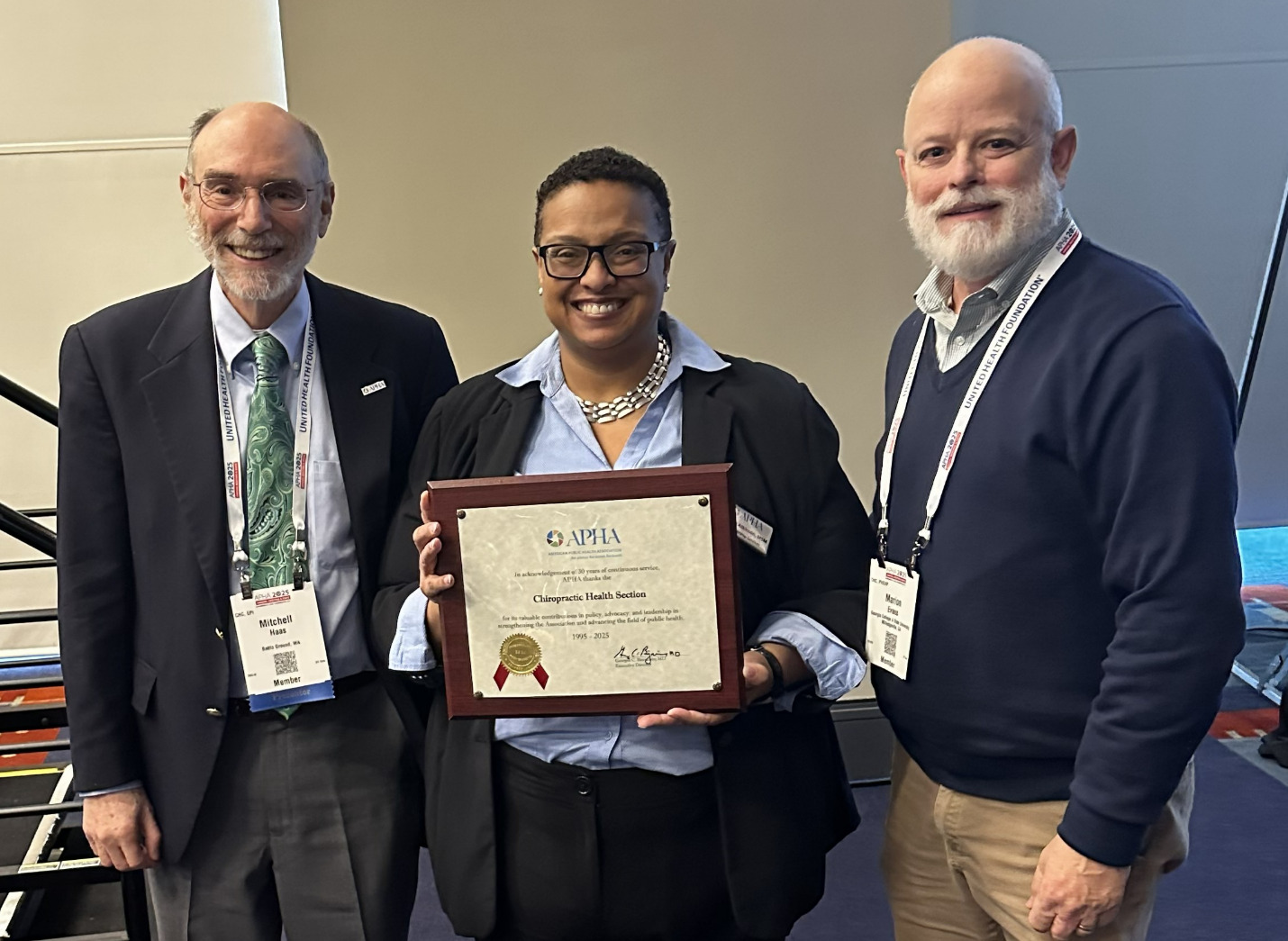
The year 2025 marks the 30th anniversary of the Chiropractic Health Care (CHC) Section within the American Public Health Association (APHA), a milestone that invites both celebrations and reflections. (Figure 1) Established in 1995, the CHC Section emerged at the intersection of 2 distinct yet increasingly aligned domains: chiropractic care and public health.1 This anniversary provides a timely opportunity to examine the history of CHC, its contributions to public health dialogue and policy, and its evolving role within APHA and the broader health landscape.

The journey toward full inclusion of chiropractic within APHA was neither linear nor assured. From 1969 to 1983, APHA policy regarded chiropractic as incompatible with sound public health practice.2 This culminated in Resolution 6903, which called for the revocation of chiropractic licensure.3 However, persistent efforts of advocates helped pave the way for change and led to the reversal of the policy through Resolution 8331 in 1983 and the creation of the Chiropractic Forum as a Special Primary Interest Group (SPIG) within APHA.4 From the outset, the CHC section sought to demonstrate the relevance of chiropractic to public health through active participation in APHA governance, contributions to peer-reviewed publications, and engagement in policy development.
The year 2025 serves as the 30th anniversary of the CHC section within the APHA. Currently, CHC is 1 of 33 APHA sections and is the only section to include both the words “health” and “care” in its title.
The purpose of this historical organizational research study was to provide a detailed retrospective and forward-thinking analysis that serves as both a historical account and a blueprint for the next generation of chiropractors’ contribution to public health. In honoring the past and envisioning the future, we recognize the distinct contributions that CHC brings to APHA and to the broader effort to advance a healthier and more inclusive society.
Methods
Study investigators evaluated CHC by reviewing archived materials available to the CHC leadership community to perform a historical organizational study.5 We searched reportative narrative and sources such as newsletters, trade magazines (e.g., Dynamic Chiropractic), and journal article publications, and we searched reportative documentary sources such as meeting minutes and internal documents. In addition, a convenience sample of senior members of the CHC section were consulted to aid in the identification of important CHC milestones. The manuscript was reviewed for accuracy, completeness, and content validity by several senior members of CHC and several others were requested to share photographs or documents. These individuals were identified through section documents, previously held leadership positions, and their contact emails were available to the research team. Responses were received from 8 of 10 of the individuals invited. Results of the archival search chronicled the development of CHC across 3 key periods: the early years (1984–2005), the growth and expansion phase (2005–2015), and the recent decade of maturation (2016–2025).
Results
The Early Years (1984-2005)
The path to full APHA section status was not straightforward, as described by Egan et al’s historical narrative of the first 10 years.6 The first step to earning section status required a policy change, as the now defunct APHA policy No. 6903 considered chiropractors a threat to public health and called for revoking their licensure.3 This policy started in 1969 and stood until 1983 when it was revised with endorsement of APHA’s Governing Council in resolution No. 8331.2,4 Thawing of APHA policies towards chiropractic overlapped with the Wilk v AMA lawsuit that was filed in 1976, and which concluded in 1987 favoring the plaintiffs and judging that “the American Medical Association (AMA) and its members participated in a conspiracy against chiropractors in violation of the nation’s antitrust laws.”7–9 In 1983, the chiropractic profession was permitted to form a Special Primary Interest Group (SPIG) within APHA, called the Chiropractic Forum.10
The chiropractic profession experienced an APHA year of “firsts” in 1985. This was the first year that chiropractors presented papers at APHA’s annual meeting,11 and the first year a chiropractor was appointed by the Governing Council.12 In 1998, a CHC member was awarded a gold watch and other recognition by APHA for recruiting more members than any individual in the organization’s 125-year history.13
These early advances and membership growth laid the foundation for the establishment of the CHC Section.14 In a 1995 Governing Council meeting, Mitch Haas, DC, MA, moved to establish the CHC Section, appropriately in alignment with the 100th anniversary of the chiropractic profession. During deliberations for the section’s approval, letters were submitted by several physicians and researchers in other fields in support of chiropractic.15 After the motion passed, Haas continued to take on new roles, including serving on the Intersectional Council Steering Committee as both a member and later as chair, and twice as Annual Meeting Planning Chair. That role gave a chiropractor the honor of introducing the U.S. Surgeon General.16 This was the first new APHA section in three years and one that coincided with the chiropractic profession’s centennial.15
The early 2000s had many other “firsts” for chiropractors within APHA. In 2000, a chiropractor served on the APHA Executive Board, a feat in itself occurring within 5 years of CHC’s charter.16 By 2002, the CHC section won an APHA Intersectional Council grant to promote collaboration between sections. With the Vision Care, Podiatry, and Oral Health sections, the team created a mega-booth for the annual APHA meeting, which won 2nd place in 2002 and 1st place in 2003 for best exhibits. This demonstrated that the CHC Section would continue to grow and collaborate in APHA’s larger efforts in the years ahead.13
Growth and Expansion (2005-2015)
As CHC continued to grow to a peak of around 500 members, its momentum extended into global public health efforts. APHA chiropractors, in consultation with several international organizations, advised on the World Health Organization’s Guidelines on Basic Training and Safety in Chiropractic, released in 2005.17 These standards would be used for minimum criteria of chiropractic education while encouraging development and practice globally. This would be the beginning of an era that called for higher standards of education for chiropractic and greater visibility within the organization, culminating with a CHC member serving as president of the Council on Chiropractic Education and as task force leader on accreditation improvements in the profession.18 Other appointments of CHC members to APHA’s larger leadership included participation on the Task Force on Aging and the Bylaws Committee. Collaborative work also grew in the late 2010s with the American Chiropractic Association (ACA), including a public health column in their e-publications.15
In solidifying the position of CHC within APHA, chiropractic professional organizations were beginning to take note of the value in public health efforts. In 2008, ACA’s House of Delegates and Board of Governors passed a statement reaffirming the support of APHA, encouraging “all Doctors of Chiropractic to join and maintain membership and become active in the APHA henceforth.”19 Additionally, Gary Auerbach, DC, BS, a founder of the World Federation of Chiropractic (WFC) and a member of WFC’s Public Health Committee, was commended for his efforts with CHC in bringing to light the importance of what would become the Framework Convention on Tobacco Control.20 This Senate provision would be signed into law by President Obama after work with APHA Executive Director, Georges Benjamin, MD.21 Publications also grew when the Journal of Manipulative and Physiologic Therapeutics (JMPT) began publication of regular public health priorities, encouraging “As chiropractic care becomes more accepted and integrated within health care delivery systems, the profession becomes more responsible for public health care issues.”22
Membership and presence of chiropractors as APHA members continued to grow in 2009, with Georges Benjamin, MD, speaking at WFC’s Biennial Conference in Montreal.23 John Scaringe, DC, EDD, of Southern California University of Health Sciences, Frank Nicchi, DC, MS, of New York Chiropractic College (now Northeast College of Health Sciences), and Joe Brimhall, DC of the University of Western States, each began to automatically enroll students as members of APHA when they began their public health studies at their institutions. Because of their efforts and vision, these 3 presidents were each given a ‘Special Award for Advancing Public Health and Chiropractic’ from the CHC section.24 The CHC section remained busy throughout the year, establishing hand and table sanitation protocols, led by Will Evans, DC, PhD, which would later be passed as the “Hygienic Recommendations for the Chiropractic Practice” by ACA’s House of Delegates; this would be renamed as a position statement of “Infection Control for Chiropractic Practice.”25 Other long-time CHC leaders, Michael Haneline, DC, MPH, and William Meeker, DC, MPH, were involved in editing and contributing to the textbook, Introduction to Public Health for Chiropractors, which would be published the following year.26 In 2013, Cheryl Hawk, DC, PhD, and Will Evans, DC, PhD, published the book, Health Promotion And Wellness: An Evidence-Based Guide To Clinical Preventative Services.27 Section members did not shy away from challenging and controversial topics, with the development of a website on vaccinations, creating the Internet-based Immunization Information Resource Web.28
In this era, many CHC members also realized success making inroads with state and local public health boards. For example, Cheryl Hawk was appointed to the Iowa Board of Health,29 and Michael Perrillo, DC, MPH was Associate Director of the New York State Department of Health Office of Health Emergency Preparedness.30 In 2006, Mitch Haas and Joe Brimhall also successfully established the Chiropractic Section in the Oregon Public Health Association, and in 2007, Mitch Haas was elected to serve as President of the Oregon Public Health Association.
CHC’s efforts brought greater representation to other organizations in 2010, with member presence at the Association for Chiropractic Colleges Research Agenda Conference (ACC-RAC). The conference theme was Public Health in the 21st Century, with CHC member Claire Johnson serving as peer-review chair, and the conference featured a variety of practical information for chiropractors related to public health, from geriatrics and fall prevention to a concluding plenary on “Subluxation and Public Health.” APHA Executive Director, Georges Benjamin spoke at the opening session on prevention and the role chiropractic might play in addressing musculoskeletal public health concerns.31 Internally, CHC submitted its first official policy to APHA, a resolution naming musculoskeletal pain as a public health problem. With the help of Paul Dougherty, DC then Section Leader and member of the United States Bone and Joint Initiative Executive Board (formerly known as the Bone and Joint Decade), this would be the first time CHC would actively submit and work to shape policy within APHA. The language was not initially approved, but the determination of the section led to resubmission and eventual approval of the policy around the public-health burden of musculoskeletal disease.24
The Last Decade (2016-2025)
Over the past decade, CHC prioritized chiropractic public health education and in major APHA initiatives, including responses to two monumental public health emergencies: the opioid epidemic and the COVID-19 pandemic.
The Nation’s Health periodically referenced chiropractic in this decade, in collaboration with National Chiropractic Health Month celebrations,32 and conversation around opioid alternatives,33 and complementary health service spending data.34 The Opioid Epidemic was declared a Public Health Emergency in 2017.35 This epidemic would create a rousing effect on the use of chiropractic care, including as a safe and effective alternative for pain management. Opioid misuse and non-pharmacological pain management became regular subjects of research and policy initiatives during this period. For example, it was found that patients who “consulted chiropractors as first providers needed fewer opioid prescriptions, surgeries, hospitalizations, emergency department visits, specialist referrals, and injection procedures.”36 These data, among others, would prove pivotal in preparing chiropractic and public health for the next major crisis of chiropractic use and necessity, a global pandemic. Even before recognition of the opioid epidemic, CHC leaders were aware of the importance of evidence-based non-pharmacological pain management. In 2015, CHC submitted a policy that was co-sponsored by the Alcohol, Tobacco, and Other Drugs Section that would evolve into part of Policy 20154, Prevention and Intervention Strategies to Decrease Misuse in Prescription Pain Medications.37 Occurring simultaneously, Dana Madigan, DC, MPH, Michele Maiers, DC, MPH, PhD, and Joseph Pfeiffer DC, led the section in development of public health competencies for the chiropractic profession, which were published in 2020.38
During the COVID-19 pandemic, chiropractors were recognized as an integral part of the healthcare system and often tasked with disseminating accurate and clear public health information to their patients, as recognized by the Department of Homeland Security.39 Along with APHA’s guidance, chiropractic licensing and educational boards collaborated with local and national organizations to ensure chiropractic remained essential as part of the healthcare workforce.40 Chiropractors were named essential healthcare workers by the U.S. Department of Homeland Security,41 opening up future discussions for APHA around universal health care importance, including chiropractic care.42 This included recognition in testimony of APHA Executive Director, Georges Benjamin in a letter to the U.S. House of Representatives Committee on Education and Labor.43
While there had been significant growth in public health in terms of both funding, education, and academia, the current era of public health remains highly politicized. Public health is political, as it aims to affect policy changes, yet rising inequities and harassment of public health workers have posed a challenge to public health growth.44 These systemic changes in public health have and will continue to shape how the CHC section can collaborate with APHA initiatives. In addition to the politicization of public health, the COVID-19 pandemic had a significant negative impact on healthcare organization memberships.45 CHC was not immune to the trend of membership decline. In an effort to begin rebuilding the section membership, CHC initiatives have included the cultivation of a social media presence to raise awareness and the development and dissemination of a public health webinar series project spearheaded by Tom Ventimiglia, DC, FACC and Robert Leach, DC, MS, RMCHES. “[The webinar series] focuses on the important role that doctors can play in not only promoting physical health but also guiding behavioral changes, addressing social determinants of health, and promoting communication and collaboration with mental health and social workers.” This series has since been recognized and adopted as an educational tool by several chiropractic political advocacy organizations and Doctor of Chiropractic training programs (Table 1). This webinar series was made possible by generous support from the National Chiropractic Mutual Insurance Company Foundation (NCMIC).46
Discussion
Looking Ahead: The Future of Chiropractic in APHA
This review described the political and professional conditions that gave rise to CHC, including the landmark policy reversals, initial research publications, and the emergence of chiropractic voices in APHA’s leadership structures, as well as challenges the section faced during public health crises such as the COVID-19 pandemic. Next, there was an exploration of CHC’s increased visibility, including its growing contributions to policy and its advocacy for issues such as aging, musculoskeletal health, sanitation protocols, and global tobacco control. Lastly, Section’s recent initiatives are discussed, including interprofessional collaboration, student engagement, public health education, and leadership in APHA’s broader governance. Alongside these historical insights, this paper highlights key challenges that have persisted throughout the section’s existence.
The mission of CHC includes the integration of chiropractic care into public health institutions and programs and the promotion of interdisciplinary communication and collaboration between chiropractors and other health professionals.47 These priorities encourage collaboration within and across professions in the next decade and beyond. Public health education has been a curriculum standard by the Council on Chiropractic Education (CCE) since 2007, allowing for greater conversation and understanding among chiropractors as healthcare professionals to engage in public health and advocacy priorities every year.48
As CHC moves forward within APHA and across organizations that intersect with public health, it remains well-positioned to influence and shape public health policy. The 2025 APHA public health priorities include setting goals around nutrition standards, both for children and food safety, as well as upholding and strengthening health coverage and services, such as the Affordable Care Act.49 These priorities align well with CHC’s mission and offer opportunities for the section to influence greater policy initiatives.
Future research in chiropractic and public health is also expected to expand alongside the development of postdoctoral programs and research infrastructure within the profession.50 Publications of research remain 1 of the top 10 essential public health services. Chiropractic research publications continue to trend towards growth, often with CHC members as authors.50 CHC members Claire Johnson, DC, MS Ed, PhD, DACBSP and Bart Green, DC, MS Ed, PhD, DACBSP serve as Editor-In-Chief for the Journal of Chiropractic Medicine,51 Journal of Chiropractic Education,52 Journal of Manipulative and Physiological Therapeutics,53 and Journal of Chiropractic Humanities,54 4 of the top 10 journals to include chiropractic education from 2020-2023.55
Alongside these historical insights, this paper highlighted the key challenges that have persisted throughout CHC’s existence, including professional disharmony, policy resistance, limitations in public awareness, unstable membership numbers, and integration within mainstream public health frameworks. These challenges have also catalyzed innovation, leadership, and a sustained commitment to bridge the gap between chiropractic and public health. CHC has a long track record of individuals stepping up to support chiropractic’s role in public health (Table 2). Looking forward, we envision an expanded role for chiropractic within APHA with emphasis on public health priorities such as aging, chronic disease prevention, integrative care models, and health equity. We have outlined some strategic recommendations for strengthening CHC’s visibility, enhancing interdisciplinary collaboration, and cultivating a new generation of chiropractors equipped to address public health concerns. In 2018, WFC called on the profession to Be EPIC (evidence-based, patient-centered, interprofessional, and collaborative).56 The Be EPIC moniker aligns well with CHC’s mission and offers an approach to guide future chiropractors interested in public health.
Limitations
This study had many limitations. First, this was not a systematic review and was limited to documents available in CHC’s electronic archives. As such, we did not undertake a systematic approach to gathering or analyzing the content, did not track the number of sources or documents reviewed, and we did not complete the search in duplicate. Second, the fastidiousness of documenting the CHC record in archived documents appeared to be individual officer-dependent. Efforts to identify important milestones from time periods with more limited available documentation were addressed by consulting senior CHC members. However, these consultations were likely limited by recall and recency bias. Further, individuals who continued to support CHC in the latter phase of their careers may have had more positive experiences than those who discontinued membership, and not reflective of the overall CHC experience.
Conclusion
Twenty years ago, CHC section leaders reported, "the present is full of potential. Chiropractors can now take an active role in the local, national, and global public health effort, fully embracing a future with chiropractic and public health together."6 Over the past three decades, CHC has not only solidified its presence within APHA but also helped reshape perceptions of chiropractic as a legitimate and valuable contributor to the field of public health. While this vision continues, a forward direction for the chiropractic profession in public health is far from certain. Continued growth requires a new generation of service-minded chiropractors to step up into leadership roles and engage both the chiropractic and public health communities. This vision has continued a similar trajectory in public health for chiropractors in their professional endeavors and within APHA. The future remains bright for improved safety, education, and collaboration of chiropractors in public health.
Acknowledgements
The authors would like to acknowledge Michele Maiers, DC, MPH, PhD, Will Evans DC, Mitchell Hass DC, MA, and Dana Madigan, DC, MPH for providing milestone guidance. The authors would also like to thank Robert Leach, DC, for his enthusiasm and leadership in identifying this project as an important initiative for the chiropractic profession.
Contributions
Study conception: CD. Reviewed archival documents: AT, TB, MR, JR, JB, KK. Drafted the manuscript: AT. Critical revision: AT, VB, MR, JR, KK, CD. Supervision: CD. All authors read and approved the final manuscript.