
INTRODUCTION
BJ Palmer’s Big Idea remains both a defining cultural touchstone and a central philosophical foundation of chiropractic practice. The saying “get the Big Idea and all else follows” is as much ingrained in the chiropractic mind as “subluxation” and “innate intelligence.” Evidence-based chiropractors often dismiss the biomedical implausibility of these ideas, yet these concepts endure, appearing on chiropractic practice websites, in organization principle statement and in motivational seminars alongside BJ’s Utopia as a guiding principle.1,2 Although peer-reviewed discussion is limited, both serve as aspirational and doctrinaire constructs rooted in Palmer’s writings and the 33 Principles, shaping beliefs, guiding practice, and inspiring both individual growth and collective professional identity.
The canon of chiropractic (DD and BJ Palmer writings and the 33 Principles) functions as a totalizing philosophy, unifying practitioner behavior and the profession’s understanding of health. At the same time the canon marginalizes itself externally and validates itself through internal coherence rather than external critique.3,4 While subluxation remains the central biological construct and the profession’s raison d’être, the axioms of the Big Idea and BJ’s Utopia persist. Their very devotion creates blind spots: ideas treated as self-evident truths escape scrutiny, potentially obscuring questions of plausibility, public health impact, and ethical responsibility.
Historical Background to Contemporary Influence
Before examining B.J. Palmer’s writings, it is important to consider 2 of his most influential constructs, The Big Idea (BI) and B.J.'s Utopia (BJU). Emerging in the late 1920s and formalized in “The Bigness of the Fellow Within”,5,6 The Big Idea asserts that a single chiropractic adjustment can trigger a chain of universal consequences, reflecting the interconnectedness of matter, energy, and Innate Intelligence.5 Concurrently, B.J.'s Utopia7 envisioned a society organized around these same principles, representing the social and institutional extension of The Big Idea. Together, these concepts illustrate the philosophical and professional framework Palmer promoted at the height of his influence. This period, roughly the late 1920s until his death in 1961, represents the intellectual and zenith of the B.J. Palmer era, which may be termed High Palmerism. It is against this backdrop of professional and ideological tension, characteristic of High Palmerism, that The BI and BJU be read. These readings should not be read merely as simple historical artifacts, but as assertions of intellectual and institutional authority. This period can be described as one in which Palmer’s authority was concentrated, dissent was marginalized, and the professional and metaphysical vision of chiropractic was fully articulated.8
Understanding the historical mixer–straight divide is essential. During Palmer’s era, devoted followers coordinated loyalty, marginalized dissent, and consolidated authority to promote the BI and BJU, while mixers formed a branch emphasizing diagnostics, physiotherapy, and adjunctive methods.9 This divide persists today as tension between subluxation-based practitioners, following patterns established during High Palmerism, and evidence-based practitioners, who prioritize research, diagnostics and outcomes. Yet, contemporary examples of these doctrinal statements persist. The International Federation of Chiropractors and Organizations (IFCO) states, “The ‘Big Idea’ of chiropractic recognizes that vertebral subluxation has far-reaching negative consequences for not only the individual but also for society and humanity”.1 The Australian Spinal Research Foundation’s (ASRF) “The Subluxation Summit” website notes, “It is time that we awaken to the potential of chiropractic, fulfilling the vision of BJ’s Utopia—a world made better through chiropractic.”.2 These statements provide evidence that the Big Idea and BJ’s Utopia continue to shape both the culture and organizational rhetoric of contemporary chiropractic practice. Contemporary governance reflects High Palmerism’s influence: the International Chiropractic Association’s (ICA) Covid-19 statement noted, “Although there are no clinical trials to substantiate a direct causal relationship between the chiropractic adjustment and increased protection from the COVID 19 virus, there is a growing body of evidence that there is a relationship between the nervous system and the immune system”10,11 and the World Federation of Chiropractic’s (WFC) Principle 4 states, “We maintain that chiropractic extends beyond the care of patients to the promotion of better health and the wellbeing of our communities.”.12 Paul13 wrote: “What is the goal of chiropractic? Is it to create BJ Palmer’s utopia which is a subluxation free world?” Thus, one can see that the elements of the BI and BJU are still being put forth overtly, covertly and inquired upon.
Purpose Rationale and Statement
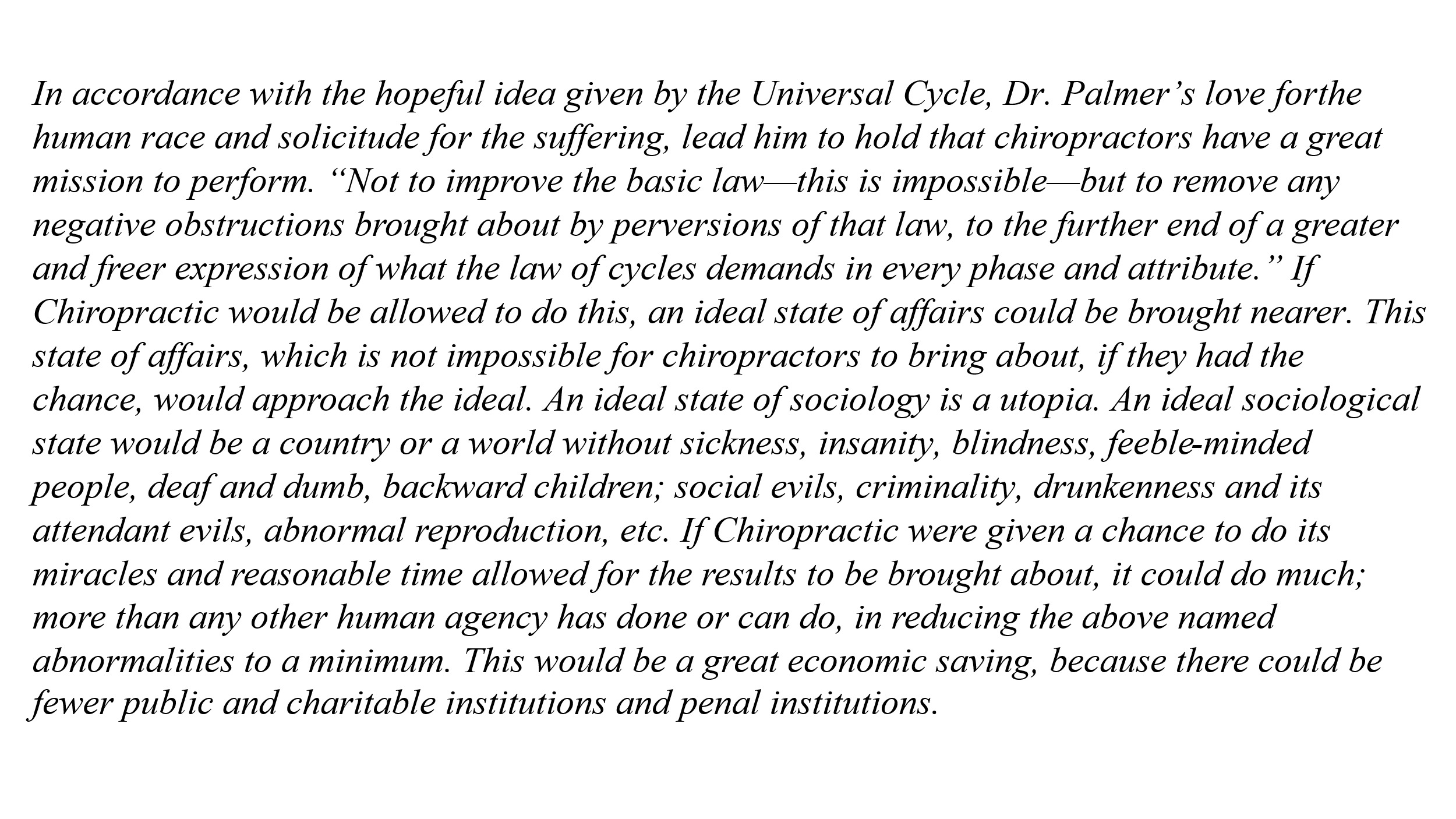
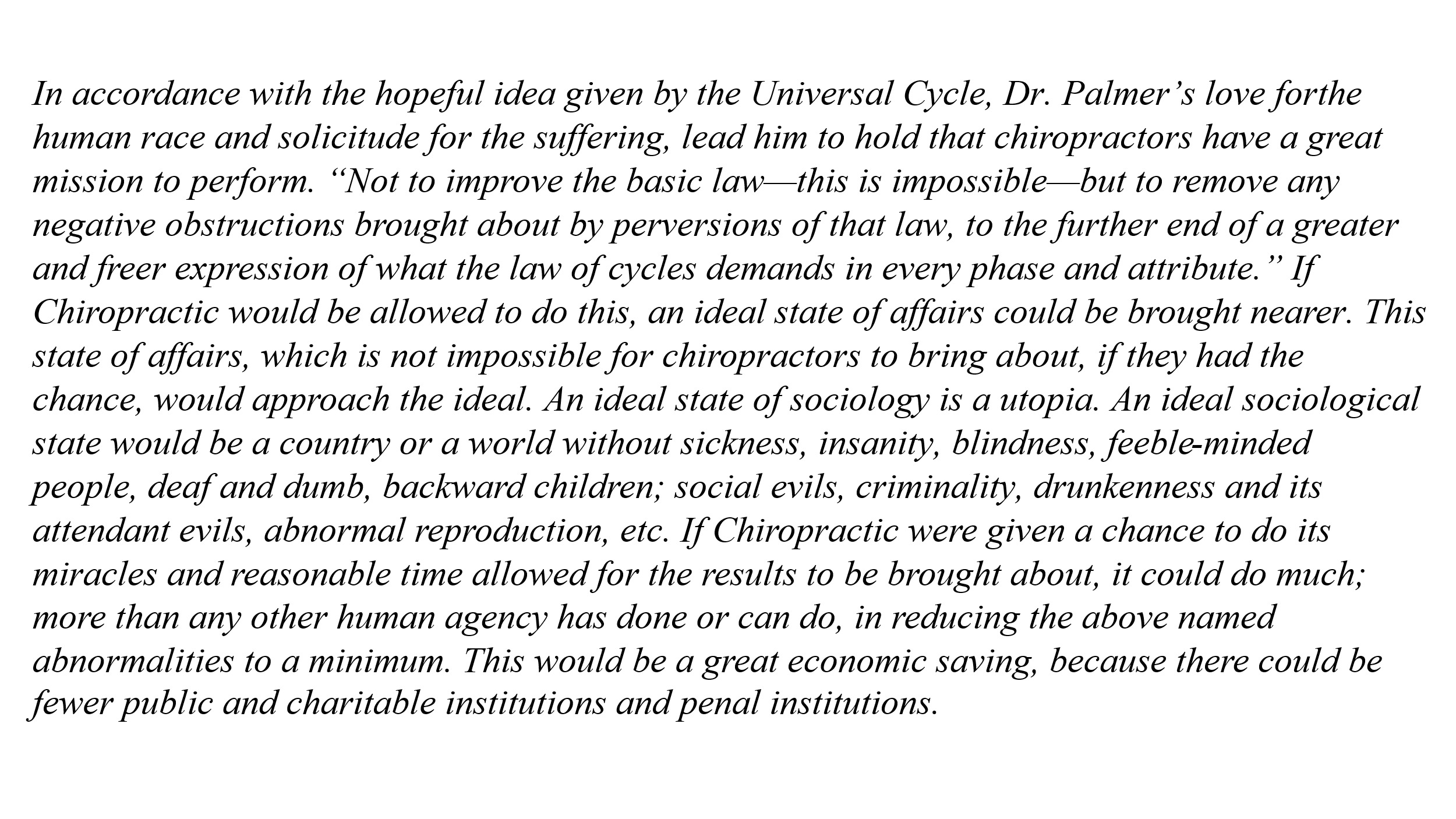
The entirety of the BI and BJU deserve mention (Figure 1 and 2). From a critical perspective, the key quotes from the BI and BJU contain phrases that can be concerning to any reader (Table 1). The BI includes statements such as “control the physical and mental welfare of a city,” “increase the efficiency of a state,” “you have produced a healthy, wealthy, and better race for posterity,” and “rebuild the thoughts and actions of the world.”5,6 The BJU includes passages like “an ideal state of sociology is a utopia,” “an ideal sociological state would be a country or a world without sickness, insanity, blindness, feeble-minded people, deaf and dumb, backward children; social evils, criminality, drunkenness and its attendant evils, abnormal reproduction, etc.,” and “This would be a great economic saving, because there could be fewer public and charitable institutions and penal institutions.”.7 Taken together, these statements suggest a vision of society in which individual action is subordinated to overarching control, raising the question of whether the philosophy and its structure exhibit a Marxist or conservative philosophical orientation. These statements, notable for their ambitious claims, provide the basis for tracing their logic across 3 vectors: philosophical, political, and public health.

The purpose of this research is to examine the core concepts contained within the BI and BJU through the contrasting lenses of Karl Marx and Russell Kirk. A secondary aim is to consider how, when fully actualized, the concepts of the BI/BJU would guide the aspirational idealization of human potential envisioned by these philosophical frameworks.
METHODS
This study utilized Textual Analysis (TA). In this study, TA was employed to examine the ideological and organizational dimensions of B.J. Palmer’s Big Idea (BI) and B.J. Palmer’s Utopia (BJU). Textual Analysis (TA) is a recognized interpretive methodology for examining written materials at multiple levels of analysis.14,15 As Park14 discussed, it can focus on micro-level aspects such as language and metaphor, meso-level structures such as themes and latent patterns, or macro-level structures such as narratives and ideological wholes. In this study, TA was applied to analyze the ideological and organizational dimensions of BI and BJU.
The analysis focused on 3 interrelated vectors, each capturing a distinct dimension of BI and BJU’s influence. The philosophical vector clarifies the conceptual foundations underpinning chiropractic thought.16 The political vector investigates institutionalization through policy, regulation, and authority consolidation within the profession.17 Finally, the public health vector examines societal consequences, including discourse, policy debates, and the profession’s role within broader healthcare systems.18 Although the Big Idea (BI) and B.J.'s Utopia (BJU) include references to economic mechanisms, and Marxist theory centrally engages with material structures, this study focuses on the philosophical, political, and public health dimensions of the BI and BJU. Economic considerations are acknowledged but are beyond the scope of this analysis.
Marx19–24 was selected as an analytical lens because his theory provides a systematic framework for understanding ideological and structural systems, including the state, shape human behavior and social organization. Concepts such as class consciousness, ideology, and the role of material and institutional structures allow BI and BJU to be analyzed as utopian interventions that attempt to align individuals with an idealized system (Table 2). Using Marx allows the analysis to identify how these interventions operate conceptually as organized, normative projects, highlighting their internal logic and systemic aspirations.
Kirk25–27 was selected as an analytical lens because his Ten Conservative Principles provide a structured framework for evaluating human nature, social order, and institutional limits. These principles include: (a) moral order, (b) custom, convention, and continuity, (c) prescription, (d) prudence, (e) variety, (f) imperfectability, (g) freedom and property linkage, (h) voluntary community and involuntary collectivism, (i) prudent restraints upon power and human passions, and (j) permanence and change26,27 (Table 2). Using Kirk allows the analysis to examine how BI and BJU interact with these intrinsic constraints, revealing tensions between aspirational interventions and the practical realities of human behavior.
Each vector was examined against the key phrases: contained in the BI and BJU (Table 1). The phrases from the BI “control the physical and mental welfare of a city”, “increase the efficiency of a state”, “you have produced a healthy, wealthy, and better race for posterity” and “rebuild the thoughts and actions of the world”5,6 are of note. With the BJU the phrases “an ideal state of sociology is a utopia”, “an ideal sociological state would be a country or a world without sickness, insanity, blindness, feeble-minded people, deaf and dumb, backward children; social evils, criminality, drunkenness and its attendant evils, abnormal reproduction, etc” and “This would be a great economic saving, because there could be fewer public and charitable institutions and penal institutions”.7 These phrases encapsulate the core organizational and normative principles uniting BI and BJU, providing a conceptual hinge for understanding their systemic influence. In this context, “normative” refers to prescriptive, value-based, and idealized expectations of how systems and individuals should function.28–30 This pairing allows for maximal contrast in normative and philosophical assumptions, providing a rigorous lens to explore tensions between utopian aspirations and human, institutional, and structural constraints.16,30
The results are presented in a series of tables, each formatted according to the thinkers under analysis: Marx and Kirk. Each table contains rows for Core, BI, and BJU. The Core row identifies central conceptual principles relevant to the vector. The BI row delineates how BI reflects or embodies the thinker’s principles. The BJU row outlines how BJU mirrors or amplifies the thinker’s vision. The tables present descriptive results with reference to theoretical frameworks, providing a structured lens while maintaining separation between observation and interpretation. This structure ensures clarity, consistency, and methodological rigor, distinctly separating descriptive results from interpretive discussion. While analysis was conducted by a single investigator, interpretive categories were grounded in established theoretical frameworks (Marxian and Kirkian), ensuring conceptual validity and methodological rigor.14,15
RESULTS
Philosophical Vector Results
Textual analysis of the Philosophical Vector is summarized in Table 2. For Marx,19–21 the Core concept identifies human behavior as shaped by class relations and material conditions, with class consciousness revealing exploitation. The BI reflects false consciousness, assuming that freedom and health result from spinal alignment rather than structural realities, while BJU projects a utopia in which human imperfection, such as crime, illness, and vice, is eliminated through subluxation correction. For Kirk,25–27 the Core concept emphasizes moral order, the diversity and imperfectability of human nature, and freedom as ordered liberty rooted in virtue and responsibility. The BI assumes human nature can be fully corrected through spinal adjustment, and BJU projects that adjustment alone can eradicate social and moral failings, creating an “ideal state of sociology.”
In sum, Table 3 presents a descriptive mapping of BI and BJU against Marxian and Kirkian principles, showing how each thinker’s core concepts frame the philosophical assumptions of chiropractic ideals without interpreting tensions or contradictions, which are addressed in the Discussion.
Political Vector
Textual analysis of the Political Vector (Table 4) maps BI and BJU against Marxian and Kirkian principles using the key phrases identified in each text. In the BI, phrases such as “control the physical and mental welfare of a city,” “increase the efficiency of a state,” and “rebuild the thoughts and actions of the world”5,6 reflect an assumption that political and social order can be engineered from subluxation-free individuals. BJU phrases, including “an ideal state of sociology is a utopia” and “fewer public and charitable institutions and penal institutions,”7 similarly imply that compulsory adjustment of subluxation produces moral, social, and political harmony.
Marx’s core idea is that the economic base shapes political institutions and the superstructure, reflecting the ruling class until the working class overthrows it.19–21 BI and BJU invert this logic, assuming spinal health determines social and political order, with the working class in control.
Kirk25–27 emphasizes that resilient political institutions require moral order, custom, continuity, prudence, respect for human variety, freedom, voluntary community, and balance between permanence and change. The BI assumes political and social harmony flows automatically from subluxation-free individuals, bypassing prudence, suppressing freedom, and subordinating voluntary community. BJU imposes alignment-based cohesion, violating the structural conditions for adaptive, morally grounded governance. This approach illustrates how BI and BJU embody normative, utopian assumptions about political order that echo Marxian structural logic while clashing with Kirkian principles of human imperfectability and voluntary social structures.
Public Health Vector
The Public Health Vector (Table 5) shows that the Big Idea (BI) and B.J. Palmer’s Utopia (BJU) function as collectivist public health frameworks, reflecting Marxist principles of centralized planning and population-level management.19–24 In Marxian theory, the State directs production and allocates resources, including health services, to preserve labor power and maintain the economic base. Prevention, treatment, and public health infrastructure serve as instruments of social management, aimed at sustaining a productive population.
The BI and BJU extend Marxian logic into chiropractic categories. Health, defined as “subluxation-free,” is treated as a public good, with practitioners functioning as agents of a centralized authority.19–24 With the BI, interventions are allocated based on population-level need rather than individual preference, reflecting Marxist principles of collective provision. The BJU intensifies this framework: by envisioning a society free of sickness, disability, “abnormal reproduction,” and social deviance, it enforces an ideologically determined standard of health through compulsory correction. In both frameworks, chiropractic practice operates as a mechanism of public resource management, aimed at optimizing the population for productivity, social order, and state-defined welfare.
From a Kirkian perspective,25–27 these frameworks are structurally and morally fragile. Public health must be guided by prudence, grounded in inherited norms, and constrained by respect for human imperfectability. Centralized, compulsory models override autonomy, moral responsibility, and the pluralistic character of real communities. Kirkian principles reject the uniformity imposed by collectivist systems, emphasizing instead local variety, voluntary association, and incremental adaptation. The BI and BJU displace these constraints, replacing prudence and liberty with procedural authority and ideological certainty. The result is a model that claims to serve the common good but in reality, would disregard the moral and social limits Kirk views as essential to sustainable public health governance.
In sum, the BI and BJU enact Marxist-style public health centralization defining health as a collectivist project while simultaneously violating Kirkian criteria of prudence, autonomy, human variety, and institutional restraint. This tension reveals how chiropractic utopianism transforms health governance into an ideological system that subordinates liberty and moral order to centralized visions of population perfection.
DISCUSSION
The Big Idea (BI) and BJ’s Utopia (BJU) have remained central to chiropractic thought and culture, shaping chiropractic thought, practice, and professional mission identity.5–7 While their prominence is widely recognized, their ideological and organizational dimensions have been underexamined. This study interpreted these phenomena through the lenses of Karl Marx19–24 and Russell Kirk25–27 to provide a systematic understanding of their conceptual and normative features. The following discussion situates these results within both historical and contemporary professional contexts.
Using the frameworks of Marx19–24 and Kirk,25–27 the following analysis examines BI and BJU across the three vectors of philosophical, political and public health, highlighting their conceptual, institutional, and societal dimensions from an interpretative perspective. This approach reveals how abstract ideals encounter resistance from behavioral and institutional realities, exposing hidden assumptions and potential areas of tension within chiropractic thought.
Philosophical
A totalizing philosophy is a system claiming to provide a unified, all-encompassing explanatory framework thus subsuming diverse phenomena under a single principle, marginalizing alternative perspectives, and validating itself by internal coherence rather than external critique.3,4 Chiropractic’s BI and BJU, grounded in canonical texts,5–7 function as totalizing frameworks by treating subluxation correction not merely as a health intervention but as a mechanism shaping cognition, morality, and social order. Marx’s theory is similarly totalizing, interpreting social phenomena through material conditions, class relations, and historical development, which determine ideology, culture, and institutions.3,4,19–24 In contrast, Kirk emphasizes human imperfection, voluntary social structures, and emergent norms, preserving pluralism and highlighting the limits of universal corrective frameworks and cannot be considered a totalizing philosophy.25–27
This contrast produces several tensions. First, human variability is ignored: BI/BJU assumes a one-size-fits-all corrective system that misrecognizes the diversity and imperfectability of human nature.25–27 Second, BI and BJU alter Marx’s base–superstructure logic, making spinal alignment the driver of social structures rather than material conditions.19–24 Third, their logic is teleological (goal-oriented)31 and deterministic (events, including human decisions, necessarily follow prior conditions),32 creating a perfectionist vision with authoritarian potential. Finally, the epistemic justification (property of a belief that makes it rational and worthy of being considered knowledge)33 mirrors Marxist totality in claiming explanatory power over all life domains, on metaphysical and biological rather than material grounds, revealing the implausibility of a universal corrective principle. Kirk would argue such a philosophy conflicts with human diversity and the impossibility of perfectibility.25–27
Philosophically, phrases like “control the physical and mental welfare of a city” and “rebuild the thoughts and actions of the world”5,6 show the BI attempting to dominate cognition and social structure, resembling a Marxist totalizing model but lacking material grounding.19–24 Phrases such as “increase the efficiency of a state” and “produce a healthy, wealthy, and better race for posterity”5,6 are deterministic, implying that alignment inevitably produces a better society. The BJU’s claim of “a country…without sickness, insanity…criminality”7 illustrates a perfectionist, unrealistic teleology, which Kirk would consider absurd.25–27 Collectively, these examples demonstrate the extreme reach of BI/BJU philosophy, attempting not merely to influence health but to engineer society itself.
These extreme claims invite the label “chiropracticum ad absurdum.” The term highlights the overreach of universal corrective assertions when applied to complex human systems, claims that are manifestly indefensible on logical grounds based on philosophy let alone science. “Chiropracticum ad absurdum” can be defined as a rhetorical fallacy in which claims are justified solely by appeal to chiropractic authority, tradition, or canonical texts rather than by evidence or reasoning. In effect, it mirrors reductio ad absurdum, a form of argument in which a proposition is shown to be untenable because assuming its negation leads to a contradiction or an absurd conclusion.34,35 While reductio ad absurdum exposes logical impossibility, chiropracticum ad absurdum exposes the absurdity of chiropractic claims that rely exclusively on authority rather than empirical support. Operationally “chiropracticum ad absurdum” occurs when claims (e.g., “the power that made the body heals the body”, “subluxation interferes with life force” and/or “nature needs no help, just no interference”) are defended through circular citation of the 33 Principles, Palmer’s writings, or appeals to “the chiropractic way,” instead of empirical demonstration. It functions to preserve canonical authority by insulating it from critique, redirecting discussion to chiropractic tradition itself, and reinforcing an insulated belief system. While the term ‘insulated belief system’ is not commonly used in the medical literature, cognitive science and psychology research provides strong support for the concept. For instance, recent work has demonstrated how dogmatic individuals show reduced informationseeking behavior when faced with uncertainty,36 how radical belief-holders fail to update their confidence in light of disconfirming evidence37 and cognitive dissonance in clinical settings can lead to denial or distortion of error.38
Political
Politics can be defined as the “societal mechanism that strives to manage conflicts that are challenging to resolve in which there are disagreements among social groups”.39 As Bambra explained, “To govern is to rule or exercise control over others. More narrowly, government relates to a set of institutions which together make (legislative), implement (executive), and interpret (judicial system) policies and laws”.40,41 Politics also reflects the underlying economic base: classes struggle over material power, and the state acts to preserve ruling-class dominance, mediating conflicts as an instrument of class interests.42 Within this context of structural control, BI and BJU should be read not merely as doctrinal propositions, but as attempts to impose ideological authority over society i.e. a Marxist-style vision in which subluxation-free individuals function as a disciplined “proletariat” (the social class of workers who do not own the means of production and must sell their labor power for wages). In this instance, subluxation-free individuals are tasked with reorganizing the world according to chiropractic principles.43–46 Such a conception mirrors totalizing regimes, in which ideological conformity is maintained under the pretense of representing the people’s will. As Overy47 observed regarding totalizing regimes: “Democracy was defined as the absence of political division and the true representation of popular interests. Each regime … was presented as if it were the people’s choice, representing and mediating on their behalf.” BI/BJU mirror this logic, claiming societal legitimacy while demanding conformity. In contrast, Kirk25–27 would warn that such totalizing claims would destabilize political order by abandoning prudence, disrupting the moral order, disregarding the richness of human variety, and replacing voluntary consent with ideological coercion.
Politics shapes policy, providing the framework through which competing interests, values, and ideologies are translated into actionable programs and institutional rules.48 The classic definition of politics is: “the process of allocation of resources, power, and benefits within society rather than ideology, morality, or mere governance structures” and in reality, “politics is who gets what, when, and how”.49 Policy formation is the process by which social and political actors (states, institutions, and interest groups) negotiate, decide, and establish formal courses of action through agenda setting, problem definition, and negotiation50 and this can occur in private and public domains and is not just limited to government. It involves reconciling competing interests and values, combining evidence, ideology, and institutional power to shape public or institutional plans, programs, or procedures.51 In the case of a totalizing ideology like BI and BJU, policy becomes subordinated to the ideology itself, designed to implement and enforce principles that must remain true to the doctrinal vision.48,51 As Schlesinger observed that is applicable today: “Policy is not born in isolation from politics. It is the child of political struggle conceived in the contest of interests and ideals that make a democracy move. Politics builds the policy, giving it shape, direction, and the means for realization”.52 Skocpol53 provided empirical evidence of this feedback in United States social policy, showing that institutionalized programs reshaped political organizations and patterns of citizen participation. This underscores that policies are not neutral; they are the product of political struggle, reflecting the priorities and power dynamics of those who govern (a dynamic that BI and BJU exploit) in their totalizing vision.48,51
In political systems, the formation of policy is deeply shaped by positive and negative rights, since the former demand active provision by the state while the latter require noninterference.54,55 Positive rights entitle individuals to certain benefits or impositions, meaning the state has a duty to provide or withhold these benefits or impositions at its whim.54 Negative rights require the state to refrain from imposing its ideals through coercion, force, or restricting individual freedoms without due process.55 For example, the right to freely practice one’s religion, speak openly, or make personal medical decisions. Simply put, positive liberty (“freedom to act…but only as the system defines”) can justify coercion in the name of empowerment whereas negative liberty (“freedom from interference”) protects individuals from such coercion, the kind of liberty that prevents totalizing ideologies from enforcing uniformity.56,57 Understanding rights is essential for analyzing how policies are shaped, since policies operationalize these obligations and freedoms.54,55
The frameworks of politics, policy and rights provide a lens to evaluate the BI and BJU, which envision social order grounded in chiropractic doctrine.58 The BI and BJU function like Marxist systems, casting subluxation-free individuals as a disciplined “proletariat” expected to reorganize society under chiropractic ideology.19–24,45,46 This mirrors Marx’s19–24 view of the state as an instrument of class domination and the “dictatorship of the proletariat”.44 Once a totalizing ideology such as advocated by the BI and BJU dominates, the political superstructure maintains itself through enforcement, legitimizing resource distribution even under stress.53 The BI and BJU assume, without basis, that order naturally flows from a subluxation-free society, yet achieving this vision would require coercion, revealing the tension between ideological determinism and practical governance.46 This subordinates prudence, diversity, and freedom, and attempts to impose such utopian arrangements clash with democratic frameworks.25–27,43
Regarding rights, BI/BJU operate as a positiverights system, where an all-powerful centralized government authority grants benefits and maintains social order only if individuals adhere to chiropractic principles.56,57 Kirk,25–27 by contrast, stresses that stable political life depends on inherited moral order, custom, prudence, and respect for human variety, encouraging voluntary community rather than chiropracticimposed collectivism. From a Kirkian25–27 viewpoint, cohesion cannot be imposed through ideology; lasting institutions require consent, diversity, and careful governance. In this sense, a Kirkian25–27 framework aligns with negative rights, where the state’s role is primarily one of noninterference, allowing social order to arise without coercion. Chait points this out clearly: “The reason every Marxist government in the history of the world turned massively repressive is not because they all had the misfortune of being hijacked by murderous thugs. It’s that the ideology itself prioritizes class justice over individual rights and makes no allowance for legitimate disagreement”.59 And because of this rigid conformity the concept of an ideology’s lust for “positive rights”, the embracing of diversity is usually met with excitement of “we embrace diversity” with the unspoken caveat of “as long as we all conform”.60 Totalizing ideologies such as the BI and BJU, when in total control, cannot tolerate any exceptions, particularly when their core beliefs are perceived to be under threat.61,62
The “chiropracticum ad absurdum” emerges across politics, policy formation, and rights. In politics, the ideological extremity of BI and BJU produces rigid expectations and the untenable claim that social order naturally arises from subluxation correction.61,63 Any policy based entirely on BI or BJU ideology is inherently flawed, as it presumes that societal order and health automatically follow from adherence to chiropractic principles.50,51 Regarding rights, a system that enforces positive rights strictly according to BI or BJU doctrine assumes that conformity to subluxation correction alone generates social order.54,55 This constitutes a chiropracticum ad absurdum because the claims of BI and BJU are justified solely by appeal to chiropractic authority, tradition, or canonical texts, rather than by empirical evidence or logical reasoning. By grounding political, policy, and rights-based claims exclusively in chiropractic doctrine, the ideology bypasses critical evaluation, producing policies and social expectations that are untenable, coercive, and disconnected from observable reality.
Public Health
Biopolitics is “the sense of control exerted on bodies through the categories of science and medicine”.64 Public health is the science and art of preventing disease, prolonging life, and promoting health through the organized efforts of society, including governments, communities, and individuals to address not only medical care but also environmental, social, economic, and political determinants of health.65,66 Control over health is never neutral; it serves as a tool through which the ruling bloc maintains hegemony by shaping consent rather than using force67. Public health, through the mechanisms of biopower, does more than preserve life; it helps constitute and enforce a social order in which bodies are governed, disciplined, and aligned with state and class imperatives.40,43,68 Biopower, defined as the governance of populations through regulatory, disciplinary, and normative control over bodies and health.69 This provides a mechanism through which the social order is maintained by producing compliant, productive subjects and is a dynamic fully intelligible through a Marxist lens. This dynamic is mirrored in contemporary public health crises, where population-level control via epidemiological surveillance, resource allocation, and statesanctioned risk management becomes a form of class discipline framed in medical discourse.70–73
From a Marxist perspective, public health policy produces compliant, disciplined subjects aligned with state needs.74 Economic control shapes bodies into productive agents, making the “healthy worker” a political construct serving state imperatives.72 The political economy of health (how political and economic domains shape individual and population health)72 shows that health discourse functions as a vehicle of class power, inseparable from production, distribution, and consumption. Defining health is therefore defining labor conditions, the value of bodies, and norms of citizenship.75 Ideological frameworks tie biological claims to economic and moral expectations, turning “health” into social order.76 In doing so, it functions as an ideological tool, aligning chiropractic subluxation correction with broader mechanisms of societal control, legitimating the existing order and securing consent through seemingly naturalized health norms.77,78
The BI and BJU operate as a political ideology structured along Marxist principles, in which health responsibility is collectivized under state control, social inequalities are reproduced, and structural determinants of ill health are obscured.72,75,77,79 They (BI and BJU) function as a counter-hegemonic formation (challenging dominant power structures while reinforcing overall social order).80–83 This contests and stabilizes state power while softening resistance to broader governance72,77 seen in typical Marxist-style governments. Health under this framework is socially defined and centrally allocated rather than individually claimed, creating an inherent tension: the collective good is prioritized over individual autonomy, and practitioners enforce centrally determined standards, privileging the ideological objectives of the system over personal choice.67,75,77
The Big Idea (BI) and BJ’s Utopia position individuals as primarily subject to externally imposed norms, thereby constraining their meaningful agency regarding health determinants (the conditions in which people are born, grow, live, work, and age, shaped by the distribution of money, power, and resources),84 while health is framed in accordance with social and economic objectives promoted by chiropractic ideology. For example, Gliedt85 advocated a shift toward a social justice model, suggesting that societal needs should take precedence over those of the profession; this reflects a Marxian collectivist ethic, wherein individual autonomy is deeply conditioned, or even overridden, by social structures and communal needs. Alderwick and Gottlieb84 highlighted that when systems treat every social risk as a social need, without assessing what patients actually prioritize, they risk implementing interventions that fail to align with individual preferences, thereby undermining meaningful agency regarding health determinants. Gliedt’s85 framing of social justice effectively prioritizes societal goals over individual agency, reflecting a Marxian collectivist ethic. Although Gliedt’s85 discussion focused on the profession’s marketing and its potential to exploit patients (a concern that is justified), this pursuit of social justice reflects the Marxist tendencies evident in BJ’s Utopia. In practice, formal equality under these centrally defined standards does not produce equal outcomes: differences in access, compliance, and social position mean that some individuals benefit more than others, reproducing existing inequalities despite the system’s egalitarian (favoring equal treatment and opportunity) intent.86,87 B.J. Palmer’s Utopia mirrors these principles: subluxation-free health is treated as a collective resource, and interventions (identification and correction of subluxations) are centrally planned for social utility. The Big Idea operationalizes a structured Marxist logic, aiming through chiropractic to align biological, social, and political life across society under a single ideological plan.
The Big Idea (BI) and BJ’s Utopia operationalize a compulsory standard of health, socially enforced rather than voluntary, and understood in current public health discourse as a coercive practice that subordinates individual autonomy to collective and ideological objectives.88,89 Practitioners become agents of a bureaucratic machine, delivering exclusively subluxation correction as societal obligations and become agents of ideological normalization rather than healers.90,91 While proponents might applaud a system that delivers global subluxation-correction from womb to tomb, the reality would almost certainly be far more contested and uneven. Historical cases underscore this risk. The Soviet Semashko model institutionalized Marxist principles through a fully socialized structure emphasizing prevention, collective responsibility, and universal access.92,93 Yet, over time, inefficiencies, underfunding, and a shift toward hospitalcentered care revealed serious implementation failures.94,95 Health in Soviet Russia was treated as a social right, with the healthcare system centrally planned and expanded to meet state-directed priorities, reflecting its integration into broader socialist economic and political structures.96,97 Yet this same political economy allowed ideological priorities to shape scientific direction, culminating in Lysenkoism which is the clearest example of what occurs when doctrine supersedes empirical inquiry. Soviet institutional authority, research agendas, and scientific training were reorganized around ideologically driven premises, resulting in scientific suppression, failed agricultural output, and long-term suppression of scientific development.98,99
Together, these cases illustrate a general principle: when public health policy is organized around non-empirical or ideologically predetermined premises, the consequences are structurally and materially harmful.94–99 Institutionalizing the BI and BJU as public policy would replicate this logic by substituting a vitalistic doctrine with a subluxation widely asserted but empirically unsupported, and unsubstantiated causation for evidence-based determinants of disease.100–102 Such a system would shape consent and compliance by delivering ideologically constructed wellness instead of empirically validated interventions.103–105 Reinhart warned: “Medical institutions may operate as ideological state apparatuses, producing practitioners whose actions align with state-sanctioned norms rather than empirical evidence”.103 Kirk would admonish such attempts based on the fact that “public measures ought to be judged by its probable long-range consequences, not merely by temporary advantage or popularity” and “a just government maintains a healthy tension between the claims of authority and the claims of liberty”.25–27
Building on Reinhart’s insight,103 the interpretive tension between literal (truth or fact) and figurative (symbol or metaphor) readings of the chiropractic BI and BJU shapes how these doctrines might influence public health policy. Taken literally, the BI and BJU, following doctrinal guidance, envision a society in which correcting subluxations alone eliminates sickness, social ills, and other perceived imperfections such that these doctrines could supplant biomedical evidence and rational public-health reasoning, analogous to the epistemic hazards exemplified by Lysenkoism in the Soviet Union.106–108 Population-level application under literal interpretation of the BI and BJU could predictably divert resources from evidence-based prevention and treatment, delay timely care, and increase preventable morbidity and mortality.109–111 Conversely, a figurative interpretation i.e. treating the BI and BJU’s prescriptions as symbolic guidance for holistic health or social well-being, renders the concepts so diffuse and obtuse that they offer no actionable value for science, policy, or public health practice112,113 further marginalizing the profession, in essence, “chiropracticum ad absurdum”.
In either case, the BI and BJU fail as viable foundations for public-health policy: literal readings threaten catastrophic consequences, whereas figurative readings offer only pop-psychology practice building, virtue-signaling inspiration, and no actionable guidance of any seriousness except further acknowledging to the world what is a “chiropracticum ad absurdum”. Kirk25–27 would regard this as a violation of prudence and moral order thus allowing the BI and BJU to have ideological overreach which would prevent safeguards and restraints on medical authority and making institutional power authoritarian. Whether interpreted literally or figuratively, the BI and BJU constitute ideological overreach into domains where empirical reality and careful judgment must prevail, thereby generating absurdities that mislead both practitioners and policymakers alike.
This interpretive ambiguity (literal vs. figurative) has real-world consequences for the present times. During the COVID-19 pandemic, the International Chiropractors Association (ICA) issued a statement noting that while no clinical trials substantiated a causal link between chiropractic adjustment and viral protection, a relationship between the nervous and immune system existed.10,11 This communication exemplifies chiropracticum ad absurdum in the form of the “motte-and-bailey” tactic. The defensible “motte” asserts a general nervous-immune interaction, while the implied “bailey” suggests chiropractic may influence immunity.114 By conceding the absence of evidence while inviting readers to infer a causal effect, the ICA relied on doctrinal authority rather than empirical validation, exemplifying a motteandbailey rhetorical structure analogous to that described by Zietsch114 and illustrating the ongoing risks of applying the BI, BJU, and chiropractic philosophy, in publichealth messaging.
Homola115 identified what could be considered the original pointing out of “chiropracticum ad absurdum” with implication on public health, writing: "…there is little doubt that subluxations of spinal vertebrae have nothing to do with the occurrence and spread of epidemic-type disease. Although most chiropractors are aware that such proposals in chiropractic literature go no further than printer’s ink, it is a terrible doctrine that should not be repeated before suggestable persons." What can be appreciated here is that claims stemming from the BI and BJU, whether interpreted literally or figuratively, have no place in the chiropractic lexicon, and any utterances of this kind are conceptually absurd. More broadly, totalizing ideologies, whether literal or figurative and applied across social life, can produce a human-made apocalypse. As Kirk observed regarding ideology: “Ideology, in short, is a political formula that promises mankind an earthly paradise; but in cruel fact what ideology has created is a series of terrestrial hells”.25
The persistence of the BI and BJU is not necessarily driven by malice or intent to deceive. It reflects “epistemic inertia”: beliefs that resist change even when contradicted by evidence, reinforced by professional insularity and identity-protective reasoning.116 Applying Hanlon’s Razor, “never attribute to malice that which can be explained by stupidity” (popularly attributed to Robert J. Hanlon in Murphy’s Law Book Two, 1980),117 suggests that these doctrines endure not from ill intent but from a kind of belief inertia, similarly reinforced by professional insularity and identity-protective reasoning.118 Historical warnings, such as Homola’s critique over 60 years ago that linking subluxations to epidemic disease was unsupported and harmful,115 illustrate that these ideas persist despite empirical refutation. Even well-meaning ideas, when shielded from empirical correction, can endure long after their explanatory power has vanished, continuing today without a Planck mass of supporting evidence. As Kirk observed, “Public measures ought to be judged by their probable long-range consequences, not merely by temporary advantage or popularity”.27
Study Limitations
The limitations of this paper stem from its scope and methodological approach. First, it examines only 2 diametrically opposed philosophies (Marx and Kirk) without comparison to other prominent philosophers such as Rousseau, Hegel, Popper, Locke, Montesquieu, Hobbes, Kierkegaard, Comte, or Kant, limiting the generalizability of the findings. Second, it focuses on selected key phraseology from the BI and BJU rather than the entire doctrinal or institutional structure, potentially overlooking broader patterns or nuances. Third, the analysis considered only 3 vectors (philosophical, political, and public health) while other potentially relevant vectors, including sociological, economic, cultural, biomedical, historical, legal/ethical, and educational, were not examined. Fourth, the interpretive nature of the analysis and the absence of multi-coder verification may introduce bias; however, categories were theory-driven and grounded in established frameworks, providing a rigorous, theory-informed assessment of the philosophical and social claims embedded in chiropractic discourse.14,15 Finally, this research is primarily theoretical and interpretive, and the effects of the BI and BJU are analyzed conceptually rather than empirically.
Potential Criticisms Beyond Study Limitations
There is little doubt that this research will attract criticism. Potential objections are addressed here to preserve analytical rigor and integrity in interpreting the BI and BJU, consistent with principles of disciplinary discourse and structured academic argumentation.119,120 First, some may claim this research is a polemic; however, the critique is grounded in evidence, theory, and interpretation. Second, critics may label this analysis “anti-chiropractic” or accuse it of spreading falsehoods and misinformation about chiropractic philosophy. Such claims misrepresent the intent of this work, which is not to discredit individual practitioners but to evaluate the structural and doctrinal implications of the BI and BJU for philosophical reasoning, policy, and public health. Third, some may invoke presentism (“Palmer was a man of his times” and “judging Palmer by today’s knowledge or standards”),121 or use ad hominem circumstantial arguments (“Palmer owned property, so he cannot be Marxist/collectivist” and “Palmer would never endorse extreme interpretations today”)122 to downplay critique. Historical evidence confirms Palmer’s consistency: during the Cold War’s Second Red Scare (1947–1957),123–126 he instructed successors to “guard it well”,127 demonstrating enduring commitment to the system without alteration. Fourth, followers may claim that the BI and BJU’s utopian assertions are purely metaphorical (i.e., not intended literally). However, such defenses do not alter the structural logic of the BI and BJU as Marxist. Regardless of Palmer’s personal circumstances or intentions, the canonical texts and operational practices function deterministically: enforcing adherence to Palmer’s dictates (continued publications), pathologizing dissent (you need a good adjustment to think right), sustaining hierarchical compliance (licensing exams tied to chiropractic philosophy), and preserving the pseudoscientific status of the subluxation independent of rational scrutiny (promotion of subluxation theory in educational seminars without critical debate). These dynamics operate structurally and doctrinally rather than being contingent on any individual practitioner’s idiosyncrasies or moral character. Fifth, some may argue that the chiropractic philosophy in these texts is not formally “canonized” as religious doctrines are. Formal codification is not a prerequisite for shaping ideology, practice norms, or public messaging. The BI and BJU function as de facto doctrinal authorities within chiropractic education and professional identity and continue to influence policy statements, albeit tempered by modern language. Sixth, while some chiropractors claim that the BI and BJU are historical and do not reflect modern chiropractic philosophy, no modern reinterpretation or revisionist analysis128 effectively challenges the assertions of the BI and BJU. The principles continue to be applied by some within the profession, leaving potential for misuse. Seventh, chiropractic philosophy, encompassing the BI and BJU, is often considered sui generis (unique in its characteristics) and incomparable to other philosophies. Nevertheless, it remains subject to comparative philosophical analysis, particularly regarding structural and societal parallels. Eighth, some may argue that this analysis constructs a straw man (i.e., misrepresenting an argument to make it easier to refute). However, the interpretations presented are drawn directly from the canonical texts and historical practices of the BI and BJU rather than any exaggerated or distorted reformulation. Ninth, followers may invoke a double standard of proof, requiring external validation for critiques while providing little or no evidence for their own claims. Analyses grounded in Marxian and Kirkian frameworks remain robust, exposing the tension between the ideology’s deterministic assertions and the complexities of human behavior, social structures, and institutional enforcement. Tenth, chiropractors may argue that the representations in this paper constitute a “slippery slope.” However, historical evidence demonstrates that when utopian ideologies operate without critical constraints, they frequently drift toward authoritarian structures characterized by suppression of dissent, surveillance, enforced homogeneity, and disciplinary control. Psychological research further indicates that adherence to absurd notions, as examined here, predictably increases support for authoritarian belief systems.129 Eleventh, the claim that the study is methodologically flawed is addressed in the limitations. However, such claims of methodological flaw are typically used by those who discover that the findings of studies do not confirm or support their beliefs. In reality, the claim of “methodological flaw” is no more a cliché in chiropractic research circles: uncreative and predictable. Finally, while critics may dismiss these parallels as overreach, empirical research shows that belief systems claiming exclusive access to truth often defend their claims through psychological mechanisms (e.g., conformity pressures, ingroup policing via virtue signaling, confirmation bias) and structural mechanisms (e.g., institutional gatekeeping, centralized authority, doctrinal enforcement). Viewed in this light, the concern is not hypothetical but grounded in historical accounts of ideologies becoming oppressive.130–132
CONCLUSION
The Big Idea (BI) and B.J. Palmer’s Utopia (BJU) occupy a central place in chiropractic thought, yet their ideological and organizational dimensions have remained largely unexamined. Using textual analysis (TA) across philosophical, political, and public health vectors, this study demonstrates that BI and BJU are functionally Marxist, exhibiting epistemic and structural logic characteristic of totalizing ideological systems. They constitute a totalizing ideology (claiming exclusive access to truth), would enact centralized authority (top-down enforcement of doctrine), induce suppression of dissent (discouraging or pathologizing deviation from doctrine), and construct institutional enforcement (embedding ideology within societal structures). Marxian principles illuminate how these frameworks project utopian social order by subordinating individual autonomy to doctrinal imperatives, while Kirkian analysis reveals profound tension with human imperfectability, moral order, and voluntary community. Key canonical phrases such as BI’s “rebuild the thoughts and actions of the world” and BJU’s “a country…without sickness, insanity, criminality” demonstrate how chiropractic ideology extends far beyond health interventions into social, political, and public health domains. Together, these findings show that BI and BJU operate as totalizing, coercive ideological systems that embody structural absurdities when assessed against human, institutional, and societal realities and stand in direct opposition to Kirk’s principles of freedom, variety, and prudent restraints on power.
Building on the literal and figurative distinctions identified in this study, the Big Idea (BI) and BJU can be interpreted in two ways, each carrying distinct risks. Aspirational readings treat the BI and BJU as a literal blueprint (a model for health, social order, or societal ideals) creating immediate risks of misapplied doctrine, ideological overreach, and potential harm in practice or policy. Inspirational readings, while not entirely benign, only appear safer, motivating reflection, societal engagement, or professional identity through mechanisms such as shared language, symbolic practices, or virtue signaling, and remain consistent with the structural and ideological patterns documented in the study. In either case, the BI and BJU operate as totalizing ideological frameworks for society. Awareness of these dynamics is critical: the BI and BJU shape both societal structures and professional identity; aspirational readings can produce harm, and inspirational readings reinforce continued ideological overreach.
Chiropractic philosophers must acknowledge that rigorous inquiry requires confronting reality as it is presented, not reshaping it to fit preconceived ideological expectations. In other words, chiropractic philosophers must see the world as it is, not as they wish it to be. Orwell’s seminal book “1984”133 is widely read as a warning against ideological overreach, not a blueprint for society. The BI and BJU, by contrast, are often treated as literal or figurative, aspirational or inspirational blueprints, but they should serve as warnings. Across philosophical, political, and public-health vectors, their institutionalization risks replacing evidence, freedom, variety, moral order, and prudence with a totalizing ideology, reflecting the explicit patterns of coercion, suppression, and centralized authority documented in this study.