Introduction
The emergence of chiropractic as a distinct healthcare profession in the early Twentieth Century was not solely a clinical or philosophical development; it was also a linguistic one. From its inception, chiropractic practitioners faced sustained legal challenges for the unlicensed practice of medicine. In this environment, language functioned as both liability and strategy.
The terminology used to describe chiropractic care, that is to say what chiropractic does, how it works, and what outcomes it produces, was subject to scrutiny by courts, legislators, and competing professions. Consequently, chiropractic lexicon evolved under pressure, shaped not only by internal theoretical development but also by the external demands of legal survival. This paper examines how this linguistic evolution unfolded, with particular attention to the relationship between lexical adaptation and legal survival.
Accordingly, this paper argues that chiropractic terminology emerged through an adaptive process involving 3 interrelated forces: legal necessity, technical differentiation, and philosophical articulation. Examination of the Palmer prosecutions, Langworthy’s innovations, and the Morikubo trial demonstrates that the profession’s lexicon was neither incidental nor purely ideological, but strategically constructed and continuously refined.
Historical writing on the origins and role of chiropractic terminology, particularly “philosophy,” have been the subject of sustained debate. Early and influential accounts by Lerner,1 Rehm,2 and later Keating3 advanced the interpretation that chiropractic philosophy emerged, or was strategically constructed, during the 1907 Morikubo trial to distinguish chiropractic from medicine in a legal context. This narrative that philosophy was ONLY a legal strategy is oversimplified and contradicted by available evidence. This misinterpretation has practical consequences: it delegitimizes philosophical inquiry within evidence-based chiropractic education and reinforces the false dichotomy that philosophy and science are inherently incompatible approaches to understanding chiropractic identity. However, this interpretation relies largely on retrospective analysis rather than contemporaneous evidence. This paper reexamines primary source material, including early publications and newspaper accounts, to demonstrate that chiropractic lexicon, both technical and philosophical, was already in development prior to the Morikubo trial and that technical differentiation, rather than philosophical argumentation, was decisive in early legal success.
Discussion
Early Lexical Conflict and Legal Consequences
In the earliest years of chiropractic, D.D. Palmer and his son, B.J. Palmer, openly asserted that chiropractic adjustments could “cure” or “heal” disease.4,5 These claims reflected chiropractic’s origins in magnetic healing and D.D. Palmer’s belief in a divinely inspired therapeutic capacity.
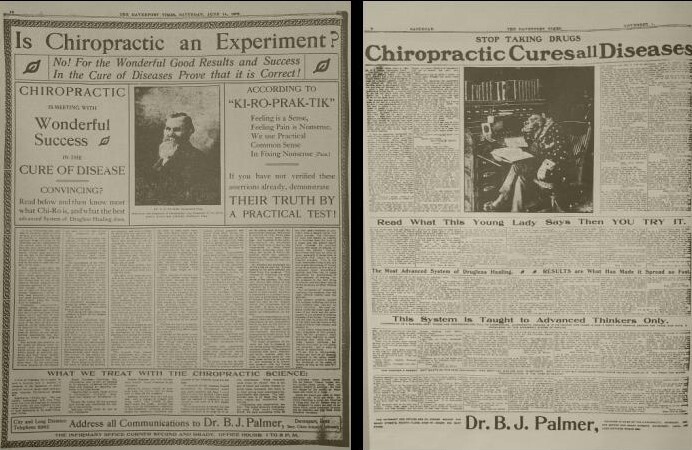
However, such terminology placed chiropractic squarely within the statutory definition of medical practice. At the turn of the twentieth century, medical practice acts commonly defined practice in part by claims to diagnose, treat, cure, or heal disease. The 1906 conviction of D.D. Palmer4 in Iowa for practicing medicine without a license illustrates the consequences of this lexical positioning (See Figure 1).
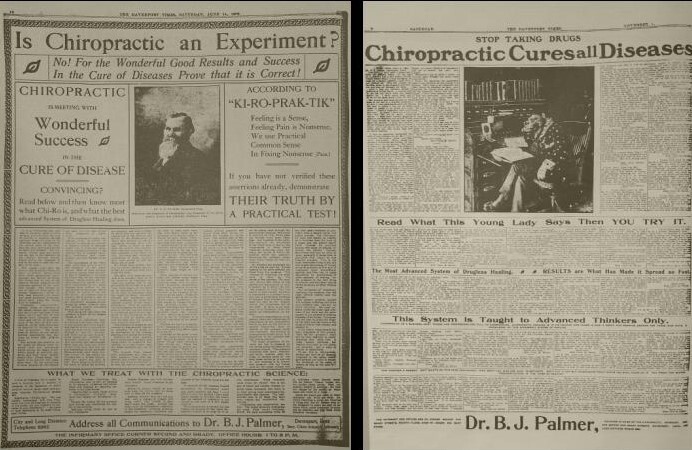
Shortly after his conviction in 1906, Palmer himself acknowledged the legal implications of such language, noting in a letter to his friend and Palmer School graduate, Solon Massey Langworthy, “This is the first letter written from my new office which is furnished by the county. I have given two adjustments which gave relief—must not say ‘cure or heal’ for the State Board has a copyright on that.”6
This moment represents a critical inflection point: terminology had become determinative of legal status. Thus, the earliest transformation of chiropractic lexicon was reactive. Language that initially served to promote the new profession became a source of legal vulnerability, necessitating rapid adaptation.
Solon M. Langworthy
Solon M. Langworthy was amongst DD Palmer’s earliest graduates. In addition to his chiropractic degree, Langworthy also obtained an osteopathy degree from the American School of Manual Therapeutics in Kansas City and had a degree in business from Bayless College. After his graduation from the Palmer School in 1901, Langworthy, a Dubuque, Iowa native, located in Cedar Rapids, Iowa to establish his chiropractic practice and later a school incorporated as the American School of Chiropractic.4
Although initially friends, Langworthy became 1 of the Palmer’s greatest competitors and challenged the Palmers for leadership of the profession. While in Cedar Rapids he became a respected member of the community and built a thriving practice and chiropractic equipment manufacturing company. Langworthy and his wife, Ora Mae, were active in their church often lending their musical talents as organists. And, Dr. Langworthy was often the vocal soloist for many of the church’s services. He was also an active member of the Cedar Rapids Country Club, rubbing shoulders with the city’s elite.7,8
Langworthy and the Emergence of a Protective Lexicon
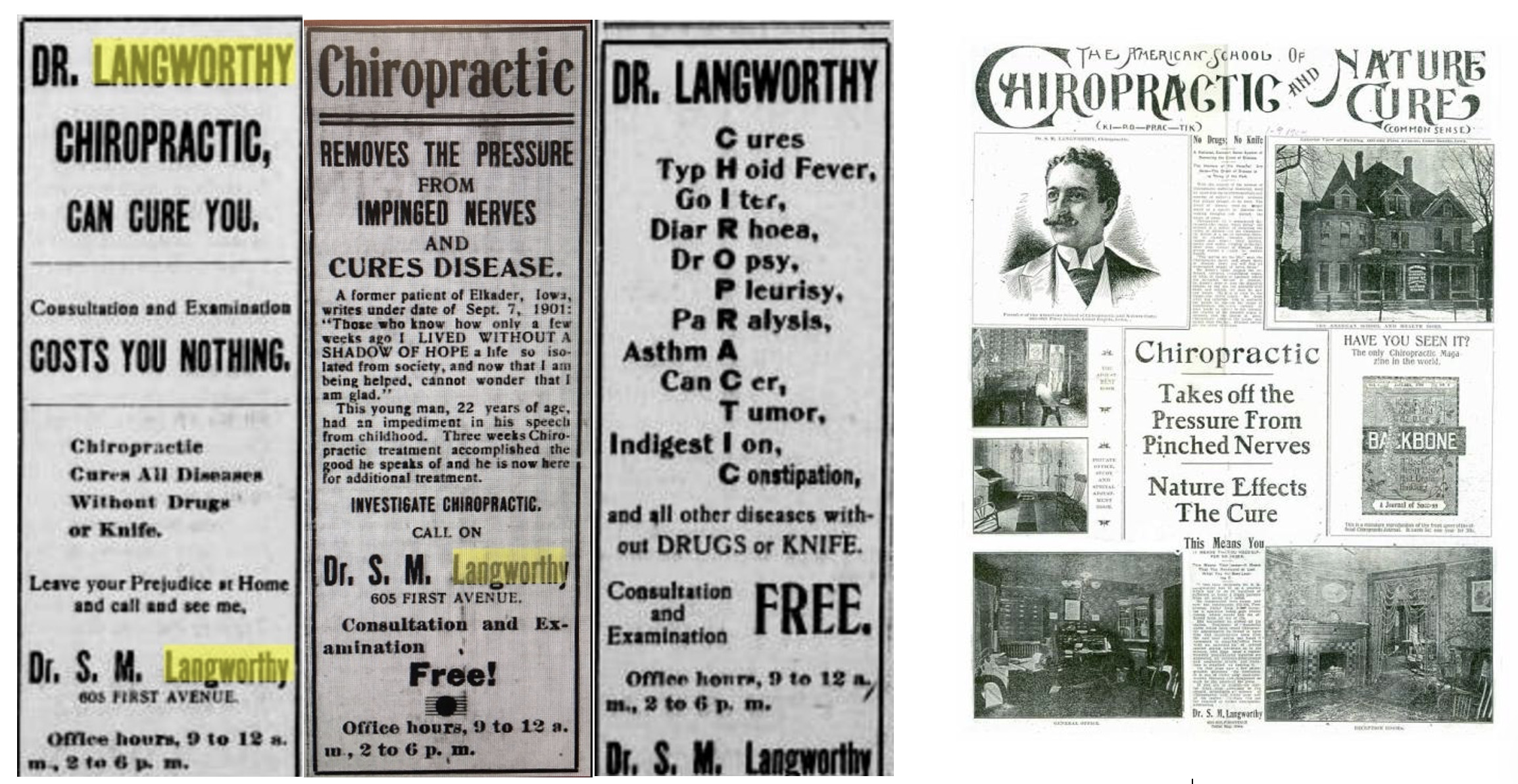
Langworthy appears to have recognized the legal implications of language more clearly and earlier than his contemporaries. In his earliest advertisements (circa 1901), Langworthy, too, used language stating that chiropractic and/or the chiropractor cured disease (Figure 2). Contrast those ads with his full-page newspaper advertisement from 1904. In this advertisement, Langworthy avoided direct claims that chiropractic adjustments cured disease. Instead, he emphasized that adjustments removed interference, allowing “Nature” to effect healing.9 (Figure 2)
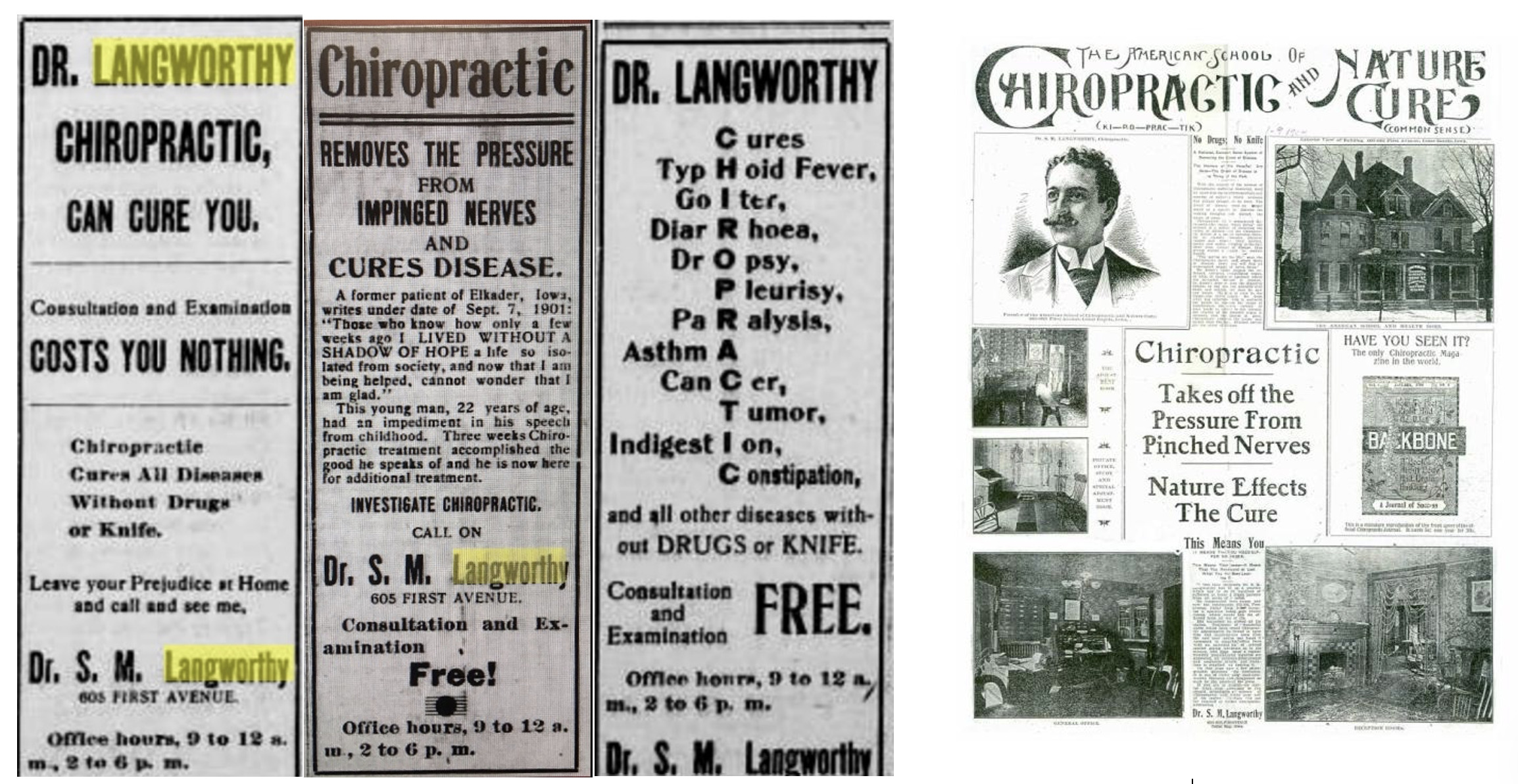
This distinction, subtle in wording but substantial in implication, reframed the chiropractor’s role from agent of cure to facilitator of natural processes. By attributing healing to the body rather than the practitioner, Langworthy effectively distanced chiropractic from the statutory definition of medical practice.
Notably, Langworthy does not appear to have been prosecuted for the unlicensed practice of medicine during his time in Iowa, in contrast to the Palmers.8 While causation cannot be definitively established, the association between linguistic strategy and legal avoidance is compelling.
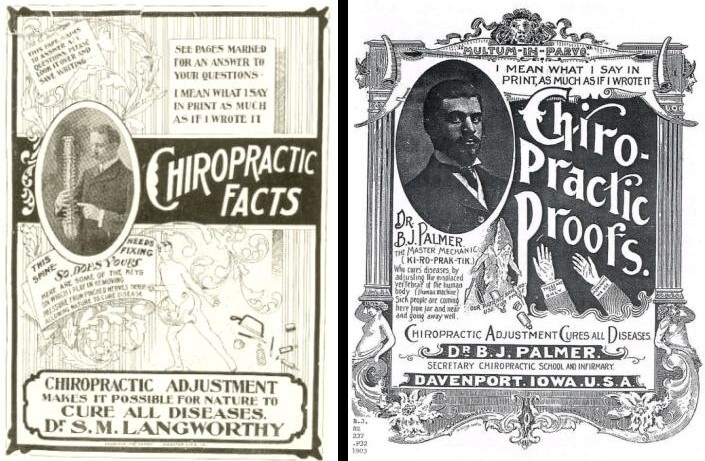
Figure 3 is a side-by-side comparison of a Langworthy advertising booklet and one produced by BJ Palmer. These booklets are from the same year, 1903. Note the subtle differences in the claims made on the covers of these publications. Langworthy exploits the loophole in Iowa law while BJ’s advertising copy clearly violates the letter of the law.
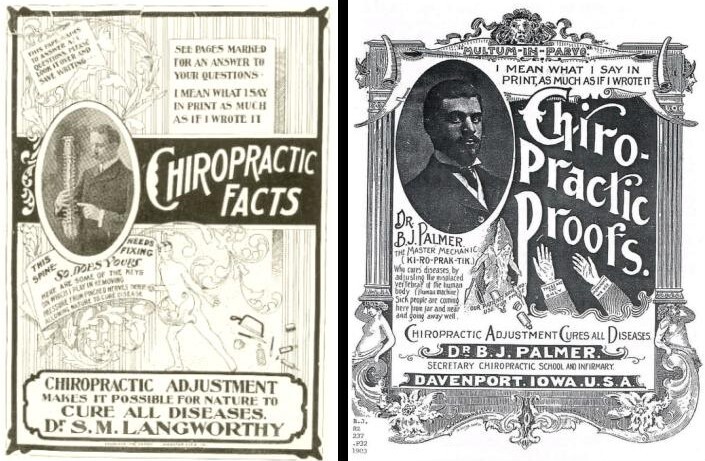
This development represents the emergence of a protective lexicon, that is terminology deliberately structured to navigate legal constraints while preserving professional function. Its influence persists in modern descriptions of chiropractic care.
Codification of Lexicon in Law and Practice
The linguistic adaptations developed in chiropractic’s formative years were eventually codified into statutory definitions of practice. As licensing laws were enacted, jurisdictions incorporated language reflecting varying interpretations of chiropractic.10
Some statutes emphasized subluxation detection and correction, while others defined chiropractic more broadly as the treatment of human ailments without drugs or surgery (Illinois). These differences reflect the institutionalization of early lexical strategies.10
Thus, terminology that initially functioned as a legal safeguard became embedded within regulatory frameworks that continues to shape practice and professional identity.
The Morikubo Trial and the Myth of Philosophical Invention
The 1907 trial of Shegatoro Morikubo has frequently been interpreted as the moment in which chiropractic philosophy was created as a legal strategy.1–3 However, this interpretation is not supported by contemporaneous evidence.
No transcript of the Wisconsin v. Morikubo trial has survived to the present. In spite of this fact, there is a method that enables us to deduce what exactly it was about the defense’s strategy that resulted in victory for Morikubo and the chiropractic profession.
There were 4 different newspapers in La Crosse that had reporters covering the trial. Seven different articles appeared in those newspapers regarding the proceedings.11,12 The impressions left with these reporters would reflect what was likely in the minds of the jurors serving on the case, since they would all have been exposed to the same evidence.
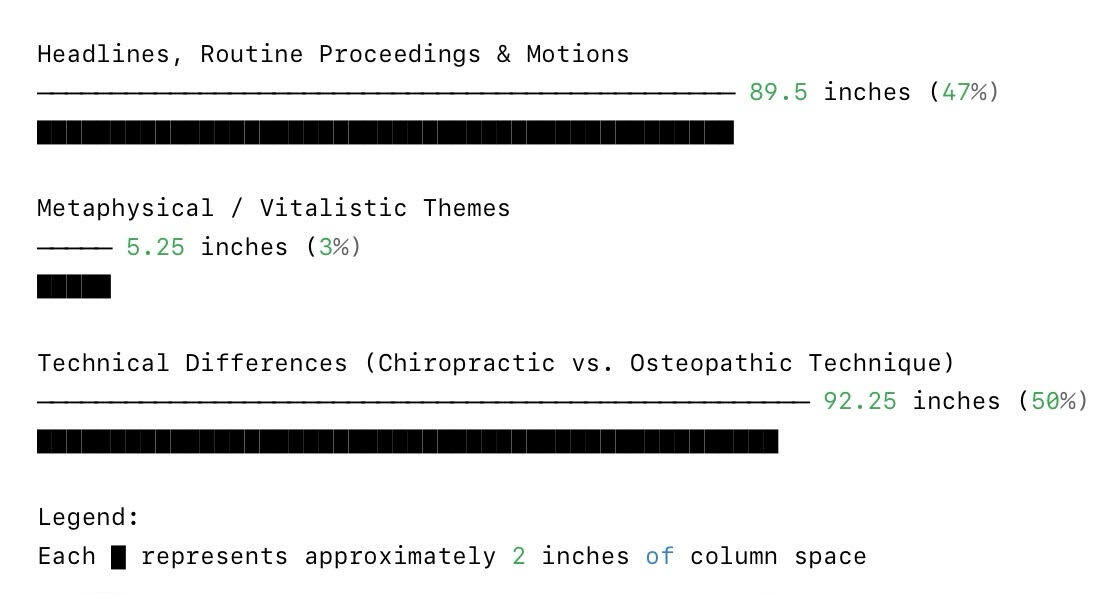
If one measures the column length of all the articles that appeared, the following accounting demonstrates how much emphasis was placed on the various themes put forth by the defense: 89.5" (47%) of the coverage was concerned with headlines, routine aspects of the proceedings and recap of the various motions made by the attorneys involved; 5.25" (3%) related to metaphysical or vitalistic themes presented by the defense; and, finally, 92.25" (50%) were dedicated to technical differences between chiropractic and osteopathic technique (manipulative methods, analysis of the spine, physiologic targets of manual interventions)12 See Figure 4.
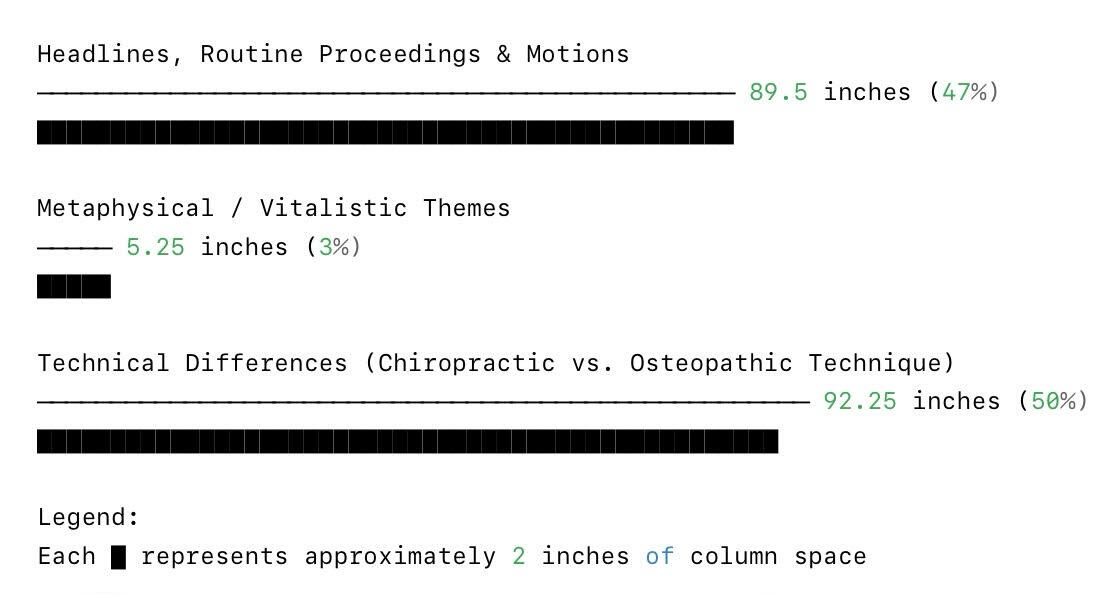
These findings suggest, though do not definitively prove, that technical differentiation was central to legal success. Alternative explanations remain possible: philosophical testimony may have been legally significant but under-reported due to its complexity, or the verdict may have reflected both technical and philosophical distinctions operating in tandem. What the evidence clearly demonstrates, however, is that the commonly repeated claim that ‘philosophy alone won the day’ oversimplifies a more complex legal strategy.
Methodological Limitations
While newspaper coverage provides valuable contemporaneous evidence, several methodological limitations must be acknowledged. First, column-inch measurement assumes proportionality between coverage and courtroom emphasis, an assumption that cannot be verified without the trial transcript. Reporters may have emphasized technical testimony due to its novelty or comprehensibility rather than its legal weight. Second, newspaper accounts reflect journalistic selection rather than complete courtroom proceedings. Despite these limitations, contemporaneous coverage remains the best available evidence and provides significant counterweight to retrospective interpretations that lack primary source support.
Pre-Existing Philosophical Lexicon
Additional evidence challenges the assertion that chiropractic philosophy originated as a courtroom construct. Prior to the Morikubo trial, chiropractic practitioners were already articulating philosophical concepts as part of their professional identity.8
Public lectures and early writings demonstrate that philosophical language, particularly concerning the integration of mind and body, was already present within the profession. Rather than being invented for legal purposes, this lexicon was selectively emphasized in response to legal challenges.8,12 For example, the Daily Times (Davenport, IA) reported on October 31, 1906 that Morikubo would deliver a public lecture titled, “Chiropractic, Its Philosophical Completeness,” indicating that philosophical discourse was already present in chiropractic prior to the 1907 trial, as reported by Troyanovich.12,13
From his lecture, Morikubo states:
“Chiropractic has solved one of the most profound philosophical problems of all ages. It has, for the first time, in the intellectual history, synthesized fragments of parts of knowledge with regard to the operations of the mind and the functions of the body into one complete and harmonious whole. Chiropractic is a science, but it is also eminently philosophical. In the future it will draw the world’s wide attention not only from scientific (sic) but also from those who contemplate on philosophical problems.” 13
Lexicon and Intra-Professional Conflict
Misinterpretations of chiropractic history have contributed to persistent divisions within the profession. The perceived dichotomy between “philosophical” and “evidence-based” chiropractors reflects, in part, a disagreement over language and its implications.8,12,13
Terms such as “treat,” “heal,” “correct,” and “facilitate” carry distinct connotations regarding scope of practice and scientific legitimacy. These debates echo early struggles to define chiropractic in legally defensible terms and highlight the continuing importance of lexicon in shaping professional identity.
The development of chiropractic lexicon is best understood as an adaptive process shaped by 3 interrelated forces:
-
Legal necessity: avoidance of terminology implying the practice of medicine
-
Technical differentiation: articulation of methods distinguishing chiropractic from competing professions
-
Philosophical articulation: expression of broader concepts regarding health and healing
These forces operated dynamically rather than independently, producing a lexicon that was flexible, strategic, and resilient. Contemporary disagreements over terminology reflect this historical interplay and underscore the enduring influence of early linguistic adaptations.
Conclusion
The chiropractic lexicon is the product of historical contingency as much as intellectual development. Early practitioners adapted their language in response to legal pressures, shaping the trajectory of the profession.
Figures such as D.D. Palmer, B.J. Palmer, Solon M. Langworthy, and Shegatoro Morikubo contributed to this evolving linguistic framework, demonstrating that language is not merely descriptive but constitutive of professional identity.
Understanding this evolution provides critical insight into contemporary debates and the future direction of chiropractic. In particular, modern disagreements over whether chiropractors “treat disease,” “manage conditions,” or “facilitate healing” are best understood as extensions of early medicolegal strategies rather than purely scientific disputes, indicating that current scope-of-practice debates remain deeply rooted in historically contingent language choices.
Disclosure
Portions of this manuscript were developed and edited with the assistance of ChatGPT (OpenAI), an AI language model. The tool was used for language refinement and organizational suggestions. All historical claims, interpretations, and citations were researched, verified, and authored by the human contributor, who retains full responsibility for the accuracy and scholarly integrity of the work.