Introduction
Leg length analysis (LLA) is a commonly used procedure among doctors of chiropractic, doctors of osteopathy, and physical therapists to ascertain the presence of anatomical or physiological dysfunction and to serve as a post-treatment evaluation tool. The most frequently used procedures to evaluate leg-length inequality (LLI) include observation, palpation, lift blocks, measuring tape, and various imaging techniques such as X-ray, CT, and MRI.1–5 While imaging techniques are generally regarded as more accurate than clinical examinations, Sabharwal and Kumar3 concluded that although imaging is the technique of choice for complicated cases, the choice of technique in daily practice is often dictated by concerns regarding time, cost, safety, reliability, and convenience.
Short-leg syndrome (SLS) is often discussed in relation to postural mechanical stress resulting from adaptational and compensational changes to an LLI.5 Literature generally divides LLI into structural (real) and functional (apparent/physiological) categories.5 Eichler6 further expanded these into 5 categories, including absolute, clinical, relative, and apparent discrepancies. Structural LLI, which may be pathological or congenital, typically involves surgical intervention, whereas functional LLI, stemming from soft tissue contractures or joint function aberrations, is commonly managed through manual therapy.
Previous literature has suggested significant correlations between LLI and clinical symptoms. Subotnick7 claimed a high correlation of injury on the short-leg side among athletes, while Giles and Taylor8 reported that LLI causes structural changes in the lumbar spine. The extent of SLS appears to correlate with the magnitude of LLI, although there is inconsistency regarding what constitutes a clinically significant discrepancy. Thresholds range from 12.5 mm9 to as small as 3 mm.10
Given the reliance on LLA in clinical decision-making, understanding the reproducibility of visual assessment is critical. Nichols11 reported that clinical observations are notoriously inaccurate, yet Cooperstein et al.12 found that prone LLI observational examination for asymptomatic subjects can be highly reliable. This study aims to evaluate the reliability of the Activator LLA protocol, a method widely practiced following the standards published by Fuhr13 among experienced practitioners.
Methods
The protocol for this study was approved by the Parker University Institutional Review Board. A total of 24 subjects (12 male and 12 female) between the ages of 18 and 60 were recruited from a student population. Ten subjects reported a history of low back pain. Exclusion criteria included the inability to tolerate a prone position for 20 minutes or falling outside the specified age range.
Subjects were randomly assigned to 3 groups of 8. To minimize confounding visual variables, all subjects wore identical socks and specialized “Activator” shoes. Three non-examiner doctors of chiropractic acted as monitors, positioning subjects on a Hy-lo activator adjusting table behind a curtain so that only the shoes and socks were visible.
Three clinicians with over 10 years of experience and advanced-proficiency ratings in the Activator Method served as examiners. Examiners were kept in separate rooms and were blindfolded during subject transitions to ensure blinding to subject identity. The examining doctors performed the Activator prone-position extended-leg protocol, analyzing the subject’s short leg in the extended position. Each clinician evaluated every patient 3 times in a predesigned randomized order (Trials A, B, and C). Subjects were unmounted and allowed to move between trials to simulate clinical conditions and prevent fatigue.
Data were recorded in 5 categories: left leg shorter by >1/4 in, left leg shorter by ≤1/4 in, equal, right leg shorter by ≤1/4 in, and right leg shorter by >1/4 in. Statistical analysis was performed using SPSS version 20.0, utilizing Kappa statistics (κ) and percentages of agreement.
Results
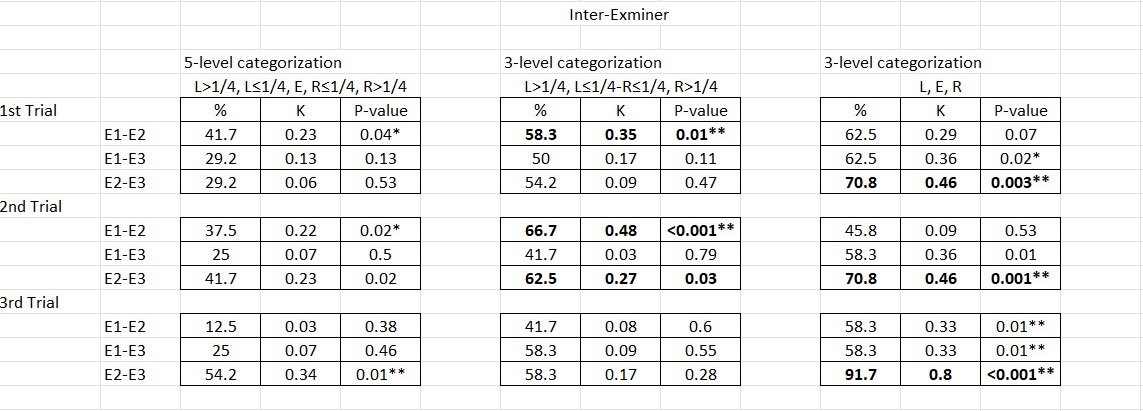
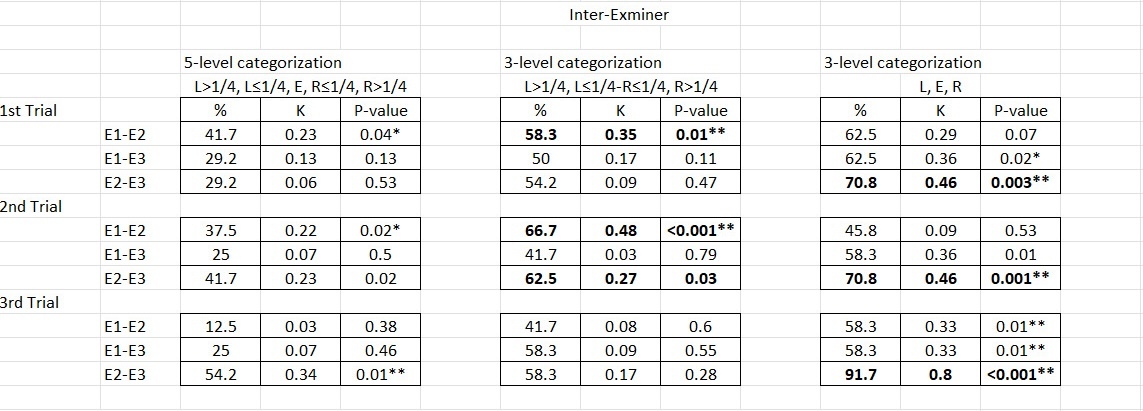
Inter-examiner reliability for determining the side of the short leg (right, left, or equal) showed significant variance between pairings. (Table 1) Between Examiners 2 and 3, agreement was moderate in the first 2 trials (κ=0.46, agreement =70.8%) and reached substantial levels in the 3rd trial (κ=0.80, agreement =91.7%). Conversely, reliability involving Examiner 1 remained lower; for example, inter-examiner agreement between Examiners 1 and 2 in detecting LLI >1/4 inwas fair to moderate (κ=0.35 to 0.48). When using the full 5-level categorization, the highest inter-examiner agreement reached was κ=0.34.
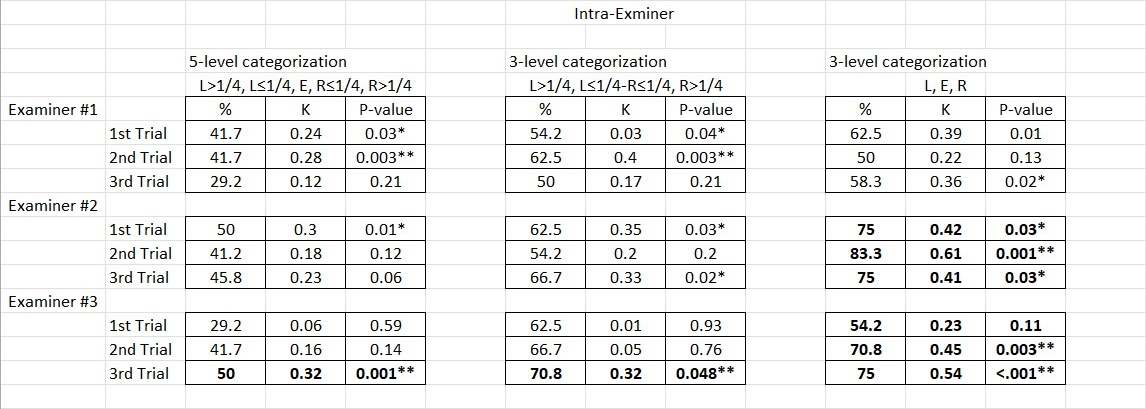
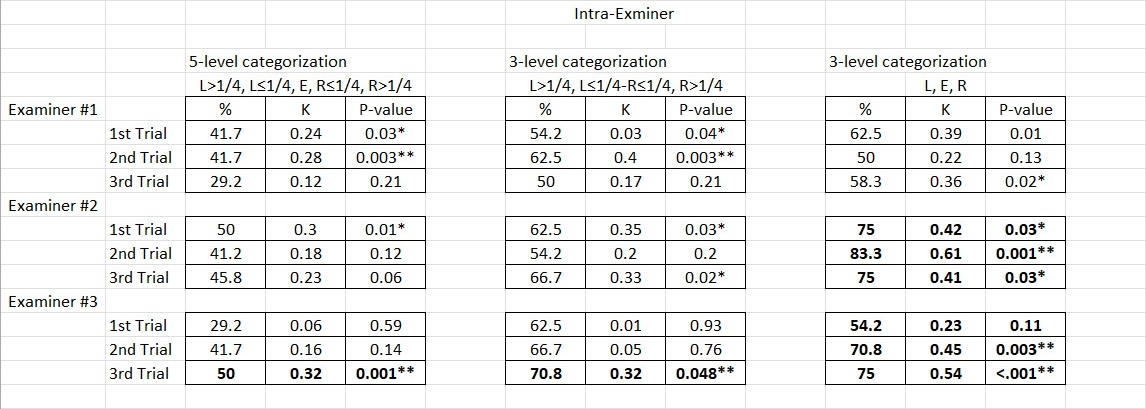
Intra-examiner reliability across trials was largely fair to moderate. (Table 2) Examiner 1 showed a peak agreement of κ=0.39(62.5% agreement). Examiner 2 demonstrated the highest consistency between trials 2 and 3 (κ=0.61, 83.3%agreement). Examiner 3 demonstrated a highest agreement of κ=0.54 (75% agreement) between the final 2 trials. When evaluating for specific magnitude (five-level categorization), all examiners demonstrated only “slight to fair” agreement across all trials.
Discussion
The data indicate that the reliability of the Activator LLA procedure is inconsistent across different practitioners. While identifying the side of a short leg reached substantial agreement between specific examiners, the fair-to-moderate results elsewhere suggest the procedure is not universally reproducible. This aligns with findings by DeBoer et al.,14 who reported fair inter-examiner reliability (κ=0.23–0.37) but moderate to substantial intra-examiner reliability (κ=0.52–0.77). Similarly, French15 reported moderate intra-examiner reliability but only fair inter-examiner reliability.
The disparity in results, specifically the high agreement between Examiners 2 and 3, suggests that shared clinical background or instructional experience may be a greater predictor of reliability than years of general practice. This is supported by Holt et al.,16 who claimed experience is a key factor in LLI findings, and Nguyen et al.,17 who found high agreement (85%, κ=0.66) among advanced-proficiency clinicians.
The marked drop in reliability when magnitude was introduced confirms that visual estimation of 1/4 in increments is a significant clinical challenge. Mannello5 noted that many studies fail to utilize correct statistical analysis and that there is no convincing evidence for the reliability of “quick” leg check techniques. Furthermore, Mannello5 argued that the larger the unit of measurement, the greater the inter-observer agreement, which explains why identifying the “side” of the short leg was more reliable than identifying the specific magnitude.
Factors such as the type of chiropractic table and whether subjects wear shoes14,18 also play roles in LLA. In this study, the requirement for subjects to be unmounted and repositioned between trials likely introduced confounding variables. While intended to simulate a clinical environment, this movement may have altered functional LLI presentation, contributing to the “slight to fair” intra-examiner agreement in magnitude estimation.
Limitations
Several limitations must be considered. First, the sample size (N=24) was small and drawn from a homogeneous student population. Second, the study lacked a “gold standard” diagnostic tool, such as radiographic imaging, to confirm anatomical length; thus, the results assess reliability (agreement) rather than accuracy. Third, the improvement in inter-examiner reliability by the third trial suggests a potential “learning effect” or subconscious recognition of subjects. Finally, patient repositioning introduced a dynamic variable that may have altered functional LLI presentation independently of examiner error.
Conclusion
The Activator LLA procedure demonstrates variable reliability. While substantial agreement can be achieved in identifying the side of a short leg among clinicians with shared training backgrounds, the procedure is not a reliable tool for quantifying LLI magnitude. Visual LLA findings should be interpreted with caution and should not be used as a standalone diagnostic for quantifying leg length discrepancies.