Introduction
Historical scholarship has developed numerous approaches for examining the ideas of historical figures. Documentary analysis, intellectual history, conceptual history, textual analysis, discourse analysis, and other qualitative historical methods have substantially advanced the study of historical writings by improving the description, interpretation, contextualization, and comparison of documentary evidence.1–4 These approaches have provided historians with increasingly sophisticated tools for understanding what historical authors wrote, how their ideas developed, and how their works interacted with broader intellectual and cultural traditions.
Despite these methodological advances, the specific operation examined here remains comparatively under-formalized: reconstructing propositions dispersed across an author’s documentary corpus into a documentarily supported model of that author’s internal explanatory architecture. Existing approaches provide important resources for documentary analysis, conceptual-framework construction, qualitative content analysis, contextual interpretation, and historical explanation, but they do not necessarily make this intermediate reconstructive operation their principal analytical object.4–6
The present approach is therefore positioned as complementary to, rather than methodologically isolated from, established traditions. Lakatos’s rational reconstruction concerns normatively informed reconstruction of scientific development; process tracing examines evidence concerning causal processes and mechanisms; and Begriffsgeschichte/conceptual history focuses principally on historical meanings, uses, and transformations of concepts. CARDA and recent historical-methods guidance provide complementary principles for transparent document analysis, audit trails, reflexivity, and reporting. DRF addresses a narrower reconstructive problem: whether documentary propositions dispersed across an author’s corpus can be connected, on documentary grounds, into an explanatory architecture attributable to that author. It does not primarily reconstruct the historical causal process by which ideas developed, trace semantic change in individual concepts, or reorganize an author’s thought according to an external normative philosophy of science.7–11
This methodological challenge is particularly relevant to the history of chiropractic philosophy. More than a century after the profession’s founding, the writings of D.D. Palmer remain the primary documentary foundation for understanding its original conceptual development. D.D. Palmer’s ideas were subsequently organized, clarified, interpreted, developed, and expanded by successive generations of chiropractic authors, contributing to the historical development of chiropractic philosophy.12–19 Collectively, these works have shaped how Palmer’s writings have been understood within the profession. However, because most investigations have focused primarily on interpretation or philosophical development, comparatively less attention has been directed toward systematically reconstructing Palmer’s own explanatory framework directly from the original documentary evidence.
This study addresses that challenge through the Four-Step Methodology. First, the relevant documentary evidence must be identified, established, and organized into a structured evidential foundation. Second, the documentary evidence must be systematically reconstructed to recover the author’s explanatory framework. Third, the reconstructed framework should undergo contextual reconstruction to examine its relationship to the scientific, philosophical, cultural, and intellectual environment in which it developed. Finally, the reconstructed and contextualized framework may be interpreted, compared with subsequent developments, or evaluated in relation to contemporary knowledge.
This study formalizes the second of these steps through the Documentary Reconstruction Framework (DRF), which provides an explicit, transparent, and documentarily traceable framework for organizing and evaluating the analytical process through which historical explanatory systems are reconstructed from documentary evidence. Without an explicit reconstruction methodology, historical interpretation may reflect the historian’s organization of documentary evidence rather than the author’s original explanatory organization.1,3
Its analytical object is the internal explanatory architecture documented across an author’s corpus: the propositions, explanatory functions, and relationships through which the author connected individual concepts into a larger explanatory system. The reconstructed architecture is therefore not treated as an externally imposed rationalization of the author’s thought; its constituent propositions and proposed relationships must remain traceable to the author’s documentary evidence. External historical, scientific, philosophical, or metaphysical material is deliberately reserved for contextual reconstruction after the documentary architecture has been established.
Similar distinctions are recognized in other areas of historical scholarship. Historians of science, for example, may distinguish between reconstructing Charles Darwin’s original explanatory framework from his own writings, reconstructing the scientific and intellectual environment in which his ideas developed, and examining the subsequent evolution of Darwinism by later authors. These represent related but analytically distinct historical questions.2,20
To demonstrate the Four-Step Methodology, the Results section presents a condensed application using Palmer’s concepts of Universal Intelligence and Innate Intelligence. These examples serve as methodological demonstrations rather than complete historical analyses. The reconstructed explanatory architecture and its broader implications for understanding Palmer’s philosophy and the chiropractic profession are then presented and discussed.
Methods
Overview of the Four-Step Methodology
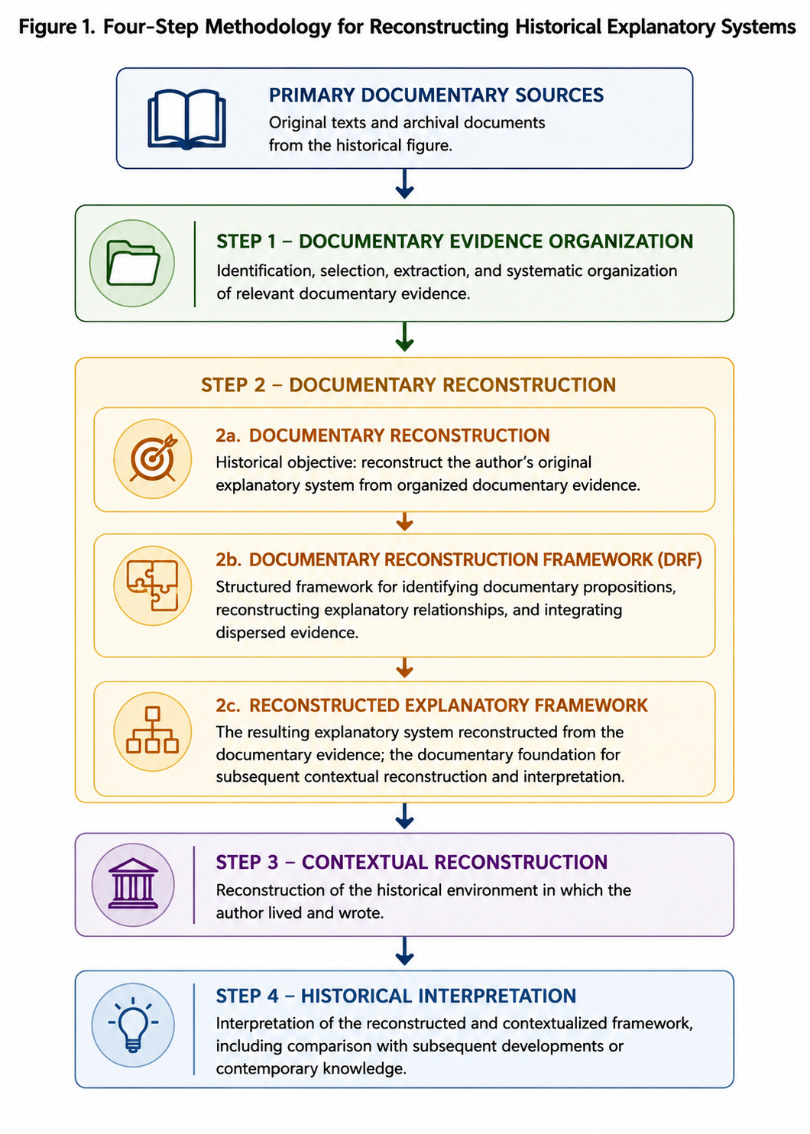
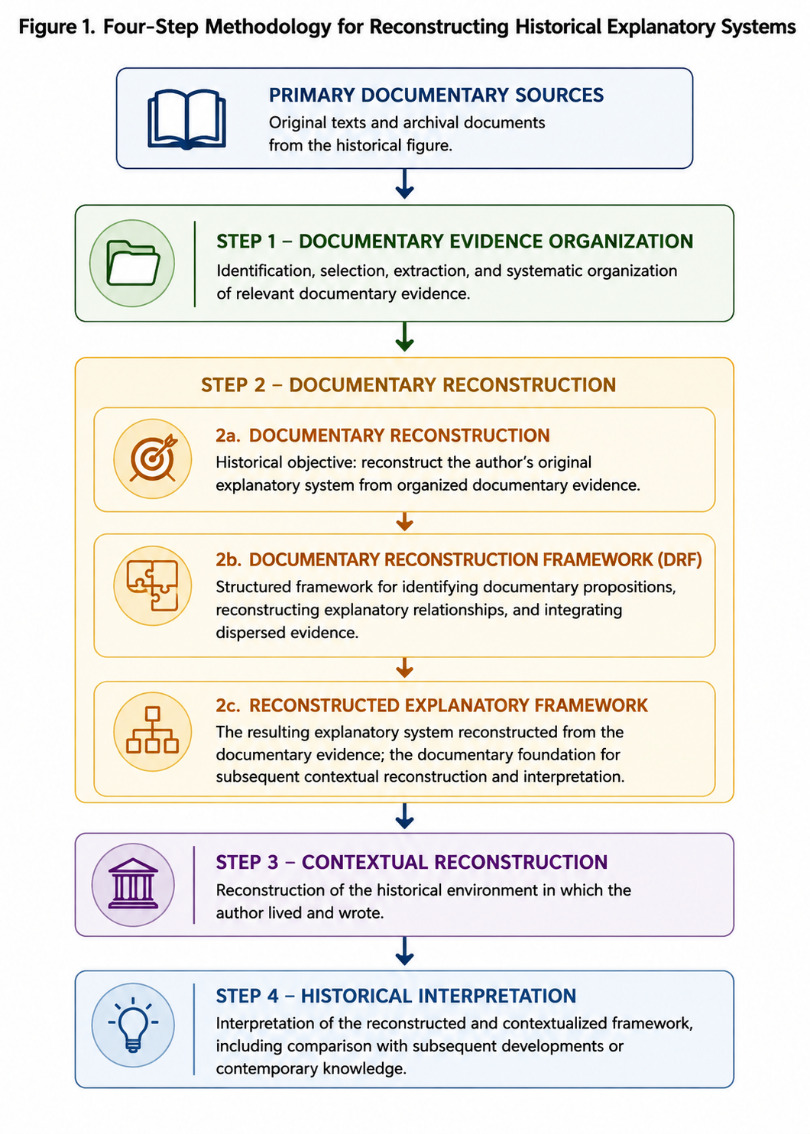
Historical investigation of original explanatory systems involves four complementary methodological steps, each addressing a distinct historical objective: documentary evidence organization, documentary reconstruction, contextual reconstruction, and historical interpretation. Together, these steps provide a structured progression from establishing the documentary evidence to reconstructing the author’s explanatory framework, situating that framework within its historical context, and subsequently interpreting or comparing it with later developments or contemporary knowledge. (Figure 1)1–4
Step 1 – Documentary Evidence Organization
The first step establishes the documentary foundation upon which reconstruction is performed, with the objective of transforming dispersed documentary material into an organized evidential foundation suitable for systematic analysis. This step includes identification of the relevant documentary sources, definition of inclusion criteria, collection of relevant documentary material, extraction of documentary evidence, organization of documentary quotations, and construction of structured evidence tables.4
For the present investigation, the principal documentary sources consisted of D.D. Palmer’s 2 major works, The Chiropractor’s Adjuster (1910) and The Chiropractor (1914). Although published posthumously, The Chiropractor has been demonstrated to represent Palmer’s own work and was therefore included as a primary documentary source.21 Documentary passages relating to Universal Intelligence and Innate Intelligence were systematically identified, extracted, cross-referenced, and organized according to their principal explanatory content.22,23
The resulting quotation libraries and structured documentary evidence tables constituted the evidential foundation for subsequent documentary reconstruction. A representative evidence-to-reconstruction trace is provided in the supplementary material, while the extended evidence tables and related research materials are addressed in the Data and Materials Availability statement.
Step 2 – Documentary Reconstruction
Following documentary evidence organization, the second step of the Four-Step Methodology consists of documentary reconstruction. This step comprises three complementary components: documentary reconstruction, the Documentary Reconstruction Framework (DRF), and the reconstructed explanatory framework, which represents the final product. Together, these components describe how organized documentary evidence is transformed into a reconstructed explanatory system.
Documentary Reconstruction
Documentary reconstruction seeks to recover the explanatory system developed by the historical author from the organized documentary evidence established during Step 1. Rather than examining individual documents or concepts in isolation, it considers the documentary evidence collectively to reconstruct the author’s original explanatory framework. The resulting reconstruction serves as the documentary foundation for subsequent contextual reconstruction and historical interpretation.1,3
The Documentary Reconstruction Framework
The Documentary Reconstruction Framework (DRF) formalizes the analytical process used to perform documentary reconstruction. Historical explanatory systems are not always presented as complete, integrated descriptions. Instead, their principal concepts, explanatory principles, biological arguments, philosophical propositions, and clinical reasoning may be dispersed across multiple documentary sources. DRF provides an explicit, transparent, and documentarily traceable framework for identifying documentary propositions, reconstructing their explanatory relationships, and integrating dispersed documentary evidence into a coherent explanatory architecture.
Although developed through reconstruction of Palmer’s writings, DRF is intended as a general framework for the documentary reconstruction of historical explanatory systems from dispersed documentary evidence, regardless of disciplinary context.
The methodological principles underlying documentary reconstruction have been introduced previously.24 The present study expands that work by integrating documentary reconstruction within the Four-Step Methodology and by formalizing DRF as the framework used to perform its documentary reconstruction step.
Development of DRF
DRF emerged during documentary reconstruction of D.D. Palmer’s concepts of Universal Intelligence and Innate Intelligence rather than being designed before those investigations began. As both studies progressed, the same analytical procedures were repeatedly required to identify documentary propositions, organize explanatory relationships, and integrate dispersed documentary evidence into coherent explanatory frameworks.
Recognition of these recurring analytical operations led to progressive formalization of the reconstruction process into the Documentary Reconstruction Framework. DRF therefore formalizes the analytical reasoning repeatedly employed during documentary reconstruction rather than introducing an entirely new historical procedure.
The formalized DRF was subsequently applied retrospectively to both reconstruction studies to examine whether explicit formalization of the analytical procedures would produce substantive changes in the original explanatory frameworks. Because the same investigator conducted the original reconstructions and the retrospective DRF application, this procedure was treated as a retrospective internal-consistency evaluation rather than independent methodological validation.
Reconstruction Process
DRF reconstructs explanatory systems progressively. Reconstruction begins with organized documentary evidence and proceeds by identifying documentary propositions relevant to the historical question. Each proposition is examined according to its explanatory role and systematically connected with related propositions throughout the documentary evidence.
Throughout reconstruction, explanatory relationships are established exclusively within the internal documentary context of the selected evidence. External historical, philosophical, or scientific comparisons are intentionally reserved for subsequent contextual reconstruction.
As relationships emerge, individual propositions are progressively integrated into broader explanatory structures until a coherent explanatory framework is reconstructed. Every proposed relationship must remain supported by documentary evidence and traceable to its original documentary source.
Because reconstruction is iterative, the developing framework is repeatedly re-examined as additional documentary evidence is incorporated. Relationships may be refined, explanatory transitions clarified, and organizational structures modified until the reconstruction provides the most coherent explanatory organization supported by the available documentary evidence. Through this iterative process, DRF identifies documentary propositions, determines their explanatory functions, reconstructs the relationships and transitions connecting them, and integrates these components into a coherent explanatory architecture.6
Critical Evaluation and Retrospective Internal-Consistency Evaluation
A defining methodological feature of DRF is continuous critical evaluation through the Negative Audit, which is applied throughout reconstruction rather than only after a reconstruction has been completed. Rather than seeking evidence that confirms the emerging reconstruction, the Negative Audit systematically searches for unsupported relationships, missing propositions, alternative documentary organizations, and inconsistencies within the developing explanatory framework.25
Whenever weaknesses are identified, the reconstruction is revised and re-evaluated against the documentary evidence. Successive analytical iterations continue until further review no longer produces substantive modification of the reconstructed explanatory architecture.
To evaluate internal consistency between the original reconstruction process and its subsequent formalization, DRF was retrospectively applied to the documentary reconstructions of Palmer’s concepts of Universal Intelligence and Innate Intelligence. Application of the formalized DRF produced no substantive modification of either reconstruction, while making the analytical decisions and documentary pathways more explicit and traceable. This finding should not be interpreted as independent validation of DRF or as evidence of inter-reconstructor reproducibility. Those properties require prospective application to previously unreconstructed material and/or independent application by additional reconstructors.
The detailed operational procedures supporting implementation of DRF were documented in a separate DRF Manual. A representative completed reconstruction trace and Negative Audit are provided as supplementary material so that readers can inspect the pathway from primary-source statement to documentary proposition, explanatory function, proposed relationship, audit decision, and corresponding component of the reconstructed architecture. The complete Manual and extended working materials remain separate research documents and their availability is specified in the Data and Materials Availability statement.
Reconstructed Explanatory Framework
The final product of documentary reconstruction is the reconstructed explanatory framework. Rather than reproducing the structure of any individual document, this framework integrates documentary propositions dispersed throughout the selected documentary sources into a coherent explanatory architecture representing the explanatory system developed by the historical author.
The reconstructed explanatory framework therefore constitutes a historical model derived from organized documentary evidence through application of the Documentary Reconstruction Framework (DRF). Every explanatory proposition, relationship, and transition within the framework remains traceable to the underlying documentary sources, ensuring methodological transparency and allowing independent evaluation of the reconstruction.
Once completed, the reconstructed explanatory framework serves as the documentary foundation for contextual reconstruction, historical interpretation, comparison with subsequent intellectual developments, and evaluation in relation to contemporary knowledge.
Illustrative Example of Step 2
The distinction between documentary reconstruction, the Documentary Reconstruction Framework (DRF), and the reconstructed explanatory framework can be illustrated using Palmer’s concept of Innate Intelligence.
During Step 1, documentary evidence organization produced an organized collection of quotations relating to Innate Intelligence extracted from The Chiropractor’s Adjuster (1910) and The Chiropractor (1914), together with their documentary references and evidence tables.22,23
During Step 2, these quotations did not yet constitute Palmer’s explanatory system. Palmer’s ideas were dispersed across multiple chapters and publications. Through DRF, these documentary statements were brought together and organized according to their explanatory relationships. Statements describing what Innate Intelligence is, where it comes from, how it acts through the nervous system, the biological functions attributed to it, and its relationship to health and disease were progressively integrated into a single explanatory framework supported by the documentary evidence.22,23
The final product of this step was a reconstructed explanatory framework representing Palmer’s explanatory system for Innate Intelligence. This framework subsequently served as the documentary foundation for contextual reconstruction and historical interpretation.
Step 3 – Contextual Reconstruction
Following documentary reconstruction, the reconstructed explanatory framework undergoes contextual reconstruction. This step reconstructs the broader scientific, philosophical, cultural, and intellectual environment within which the explanatory system developed, allowing the framework to be understood within its original historical setting.1,3
Unlike documentary reconstruction, which relies on the primary documentary evidence, contextual reconstruction incorporates additional historical sources to reconstruct the contemporary intellectual landscape surrounding the explanatory system. Depending on the historical question, these sources may include contemporary scientific literature, philosophical and metaphysical traditions, educational influences, professional debates, and other documentary evidence relevant to the historical environment in which the author’s ideas developed.
For contextual reconstruction, comparative evidence was systematically organized in historical comparison tables. These tables aligned specific components of Palmer’s reconstructed explanatory framework with relevant concepts, explanatory problems, and propositions identified in contemporaneous scientific, philosophical, and metaphysical sources and in contemporary scientific literature. The documentary basis for each comparison was reviewed to distinguish supported contextual parallels from speculative similarities and to avoid inferring intellectual influence, conceptual equivalence, or direct transmission where these were not documented. Each proposed comparison was subsequently audited against the underlying sources to verify documentary support and to identify unsupported parallels, anachronistic interpretations, or claims of influence or equivalence not established by the evidence.
Within the present paper, contextual reconstruction was performed after documentary reconstruction to preserve the independence of the reconstructed explanatory framework before external historical evidence was introduced. The reconstructed concepts of Universal Intelligence and Innate Intelligence were subsequently examined in relation to contemporary physiology, nineteenth-century metaphysical traditions, particularly Swedenborgian correspondence and related metaphysical movements, and the broader scientific, philosophical, and intellectual environment of Palmer’s lifetime. Contextual reconstruction also incorporated Palmer’s documented biographical background, the historical origins of chiropractic, and comparative analyses of physiological knowledge available during his lifetime and contemporary scientific understanding.
The historical scientific, philosophical, metaphysical, and biographical background supporting this contextual reconstruction is presented in The Ultimate Biography of D.D. Palmer: Origins of the Chiropractic Profession,26 while additional historical comparative analyses were developed alongside the reconstructions of Universal Intelligence and Innate Intelligence and documented in unpublished research tables and source-audit materials maintained within the present research program.
Step 4 – Historical Interpretation
The fourth and final step consists of historical interpretation. Following documentary reconstruction and contextual reconstruction, the reconstructed explanatory framework may be interpreted in relation to the author’s original intentions, compared with subsequent philosophical developments, examined within broader historical debates, or evaluated in relation to contemporary scientific knowledge.1–3
Unlike documentary reconstruction, which seeks to reconstruct the author’s explanatory system from the documentary evidence, historical interpretation investigates the meaning, significance, and implications of the reconstructed framework. It is also distinct from contextual reconstruction, which establishes the scientific, philosophical, cultural, and intellectual environment surrounding the explanatory system. Historical interpretation therefore builds upon the reconstructed and contextualized framework to examine its meaning, historical significance, subsequent development, contemporary implications, or relationship to later knowledge.
Within the present study, historical interpretation included interpretation of Palmer’s reconstructed explanatory system, evaluation of its historical significance, examination of its relationship to the scientific, philosophical, and metaphysical environment of his period, comparison with contemporary scientific knowledge, and consideration of its implications for understanding Palmer’s chiropractic philosophy.
Results
Application of the Four-Step Methodology
The Four-Step Methodology described here was formalized through reconstruction of D.D. Palmer’s concepts of Universal Intelligence and Innate Intelligence, with DRF subsequently applied retrospectively to evaluate the documentary reconstructions. Step 1 produced organized quotation libraries and structured documentary evidence tables from Palmer’s principal philosophical writings. Step 2 applied documentary reconstruction through the Documentary Reconstruction Framework (DRF) to reconstruct Palmer’s explanatory systems from these organized documentary datasets. Step 3 subsequently situated the reconstructed frameworks within their broader scientific, philosophical, metaphysical, and historical contexts, while Step 4 generated historical interpretations concerning Palmer’s philosophy and its implications for the chiropractic profession.
Illustrative Application of the Four-Step Methodology
For Universal Intelligence, documentary reconstruction identified a hierarchical explanatory framework in which Universal Intelligence functioned as the organizing principle underlying the origin, organization, and governance of the universe. Documentary propositions concerning force, matter, intelligence, natural law, and universal order were identified throughout Palmer’s writings and reconstructed according to their documented explanatory relationships into an integrated architecture that Palmer did not himself present as a single unified framework.22,23
For Innate Intelligence, documentary reconstruction identified a distinct but related explanatory framework describing the internal biological organization of living organisms. Documentary propositions concerning development, physiological regulation, adaptation, repair, and health were reconstructed into an integrated explanatory system through which Palmer explained biological organization and its relationship to health.22,23
Reconstructed Explanatory Framework
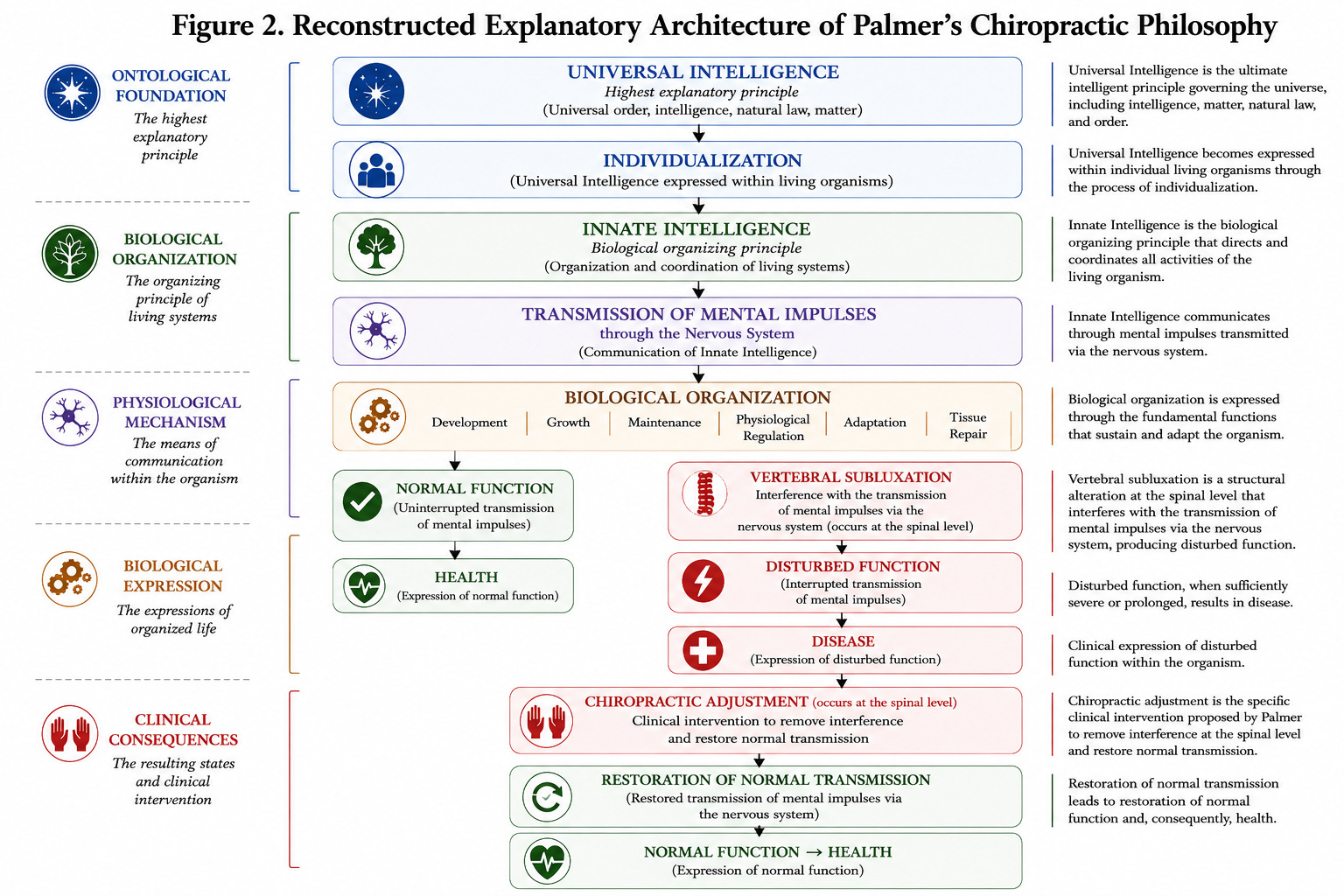
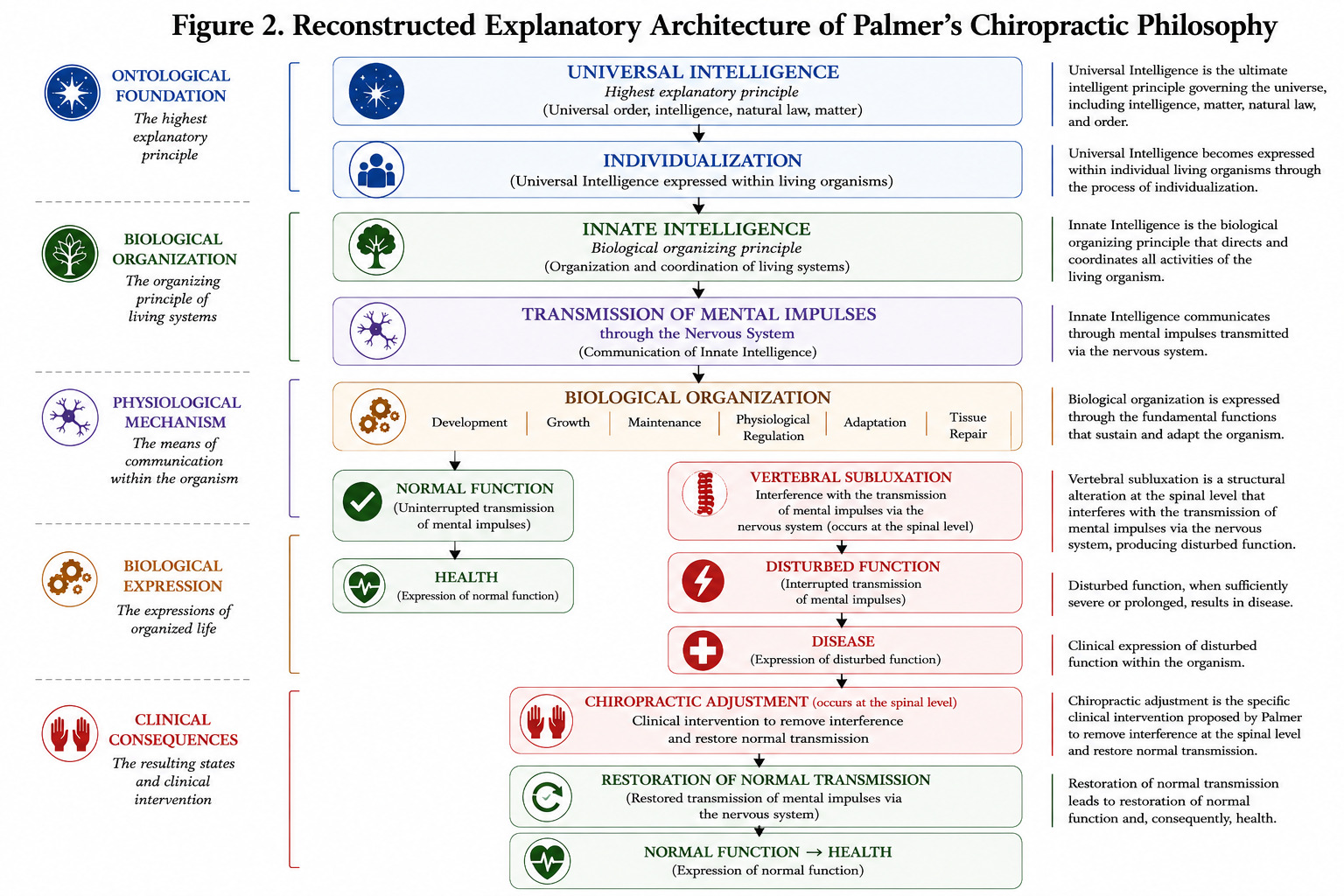
Terminological note. Terminology is simplified to facilitate visualization of Palmer’s explanatory architecture. In his later writings, Palmer described the chiropractic lesion in terms of abnormal relationships between adjacent vertebral articular surfaces while continuing to use terms such as chiropractic subluxation and luxation. “Interference with transmission” does not imply complete interruption; Palmer’s mature explanations emphasized alterations in nerve tension, vibration, and impulsive force. Accordingly, “disturbed function” and “restoration of normal transmission” are simplified descriptors of abnormal physiological function and its proposed restoration following chiropractic adjustment.
Application of documentary reconstruction through DRF produced the integrated explanatory architecture shown in Figure 2. Although Palmer never presented this explanatory system as a single complete diagram, documentary reconstruction demonstrated that propositions dispersed throughout The Chiropractor’s Adjuster (1910) and The Chiropractor (1914) collectively support an explanatory framework extending from Universal Intelligence to chiropractic adjustment.The figure represents the principal methodological product of documentary reconstruction through DRF rather than the evidentiary audit trail itself. A representative portion of that audit trail is provided in the supplementary material, linking primary-source statements to reconstructed relationships and to the corresponding segment of Figure 2. The reconstructed architecture then provides a foundation for subsequent contextual reconstruction, historical interpretation, and scholarly evaluation.
At the highest explanatory level, Universal Intelligence emerged as the foundational principle from which the remainder of Palmer’s philosophy develops. Rather than functioning as an isolated metaphysical doctrine, Universal Intelligence repeatedly serves as Palmer’s explanation for universal order and establishes the conditions upon which progressively narrower explanatory domains are constructed. Reconstruction further demonstrated that Palmer reasoned through successive explanatory transitions rather than isolated concepts. Universal Intelligence gives rise through individualization to Innate Intelligence, which in turn provides the organizing principle for biological organization and physiological function. Normal or disturbed function subsequently relates to health or disease, while vertebral subluxation and chiropractic adjustment occupy the terminal pathological and clinical levels of the reconstructed framework.22,23
Within this reconstructed architecture, Innate Intelligence emerged as Palmer’s biological explanatory principle. Rather than explaining individual biological functions independently, Innate Intelligence explains the continuous organization of the living organism. Development, growth, physiological regulation, adaptation, maintenance, tissue repair, health, and disease therefore appear within Palmer’s framework as related expressions or consequences of organized biological life rather than as independent explanatory processes.22,23
Mental impulses and the nervous system occupied an intermediate explanatory position linking Innate Intelligence with biological function. Within Palmer’s framework, the nervous system functions as the pathway through which Innate Intelligence expresses its organizing activity, while normal and disturbed physiological function represent the biological consequences of normal or disrupted expression. Vertebral subluxation occupies the pathological position within this explanatory system by interfering with the normal transmission or expression of mental impulses at the spinal level, whereas chiropractic adjustment represents Palmer’s proposed clinical intervention for restoring normal physiological function.22,23
Historical Insights Emerging from Documentary Reconstruction
Beyond reconstructing Palmer’s explanatory architecture, documentary reconstruction produced several historical insights that became apparent only after dispersed documentary propositions had been systematically integrated into a coherent explanatory framework.
First, reconstruction suggested that Universal Intelligence should be understood primarily through its explanatory function rather than its definition. Palmer consistently introduced Universal Intelligence when attempting to explain why organized order exists, not simply to describe a philosophical concept. Consequently, the historical question shifted from What did Palmer mean by Universal Intelligence? to What explanatory problem was Palmer attempting to solve through Universal Intelligence?
Second, reconstruction indicated that the central explanatory problem underlying Palmer’s philosophy was organization. Universal Intelligence explained the organization of the universe, whereas Innate Intelligence explained the organization of living systems. This recurring pattern suggested that Palmer’s philosophy was fundamentally concerned with how organized systems originate, persist, and function, with Universal and Innate Intelligence representing explanatory principles operating at different organizational levels rather than unrelated philosophical concepts.
Third, Palmer’s philosophy emerged as a hierarchical explanatory architecture rather than a collection of independent doctrines. Individual concepts occupied distinct explanatory positions and derived their meaning from their relationships with preceding and subsequent explanatory levels. Universal Intelligence, Innate Intelligence, health, disease, and chiropractic therefore became understandable primarily through their position within the reconstructed explanatory system rather than through isolated definitions.
Fourth, documentary reconstruction suggested that Palmer consistently sought to explain enabling conditions rather than isolated events. Universal Intelligence explained the conditions required for universal order, whereas Innate Intelligence explained the conditions that permitted organized biological life. Growth, adaptation, physiological regulation, tissue repair, health, and disease consequently emerged as downstream expressions of organized systems rather than as independent explanatory targets.
The historical insights generated through documentary reconstruction differed according to explanatory level. Reconstruction of Universal Intelligence principally clarified Palmer’s universal explanatory organization, whereas reconstruction of Innate Intelligence clarified the organization of his biological explanatory system. Considered together, they indicate an architecture extending from universal organization to biological organization and ultimately to chiropractic practice (Table 1).
Contextual Reconstruction and Historical Interpretation
Contextual reconstruction situated Palmer’s reconstructed explanatory framework within the social, medical, scientific, philosophical, and metaphysical environment in which it developed. Palmer formulated chiropractic during a transitional period in American health care characterized by therapeutic pluralism, competing theories of disease and healing, uneven medical education, contested professional authority, and continuing public interest in natural and noninvasive approaches to health. At the same time, scientific medicine was undergoing substantial transformation through the development of laboratory research, bacteriology, germ theory, and increasingly standardized medical education and professional institutions. Importantly, much of Palmer’s worldview developed before this transformation had become consolidated in American medicine; during his formative period, older explanatory models coexisted with emerging scientific approaches and multiple alternative systems of healing.26,27
The scientific context was similarly heterogeneous. Nineteenth- and early 20th-Century physiologists investigated fundamental problems concerning the organization and regulation of living organisms through increasingly experimental approaches. Claude Bernard’s concept of the milieu intérieur emphasized maintenance of the internal environment, while contemporary physiological texts by Foster, Landois, and Howell increasingly explained bodily function through experimentally investigated nervous, circulatory, metabolic, and regulatory processes.28–31 At the same time, broader biological debates concerning organization and the nature of living systems remained active, including Driesch’s vitalistic interpretation of organismal development.32 Palmer therefore developed his system during a period in which biological organization, physiological regulation, and the nature of life remained important explanatory problems, although his proposed explanations differed substantially from those emerging within experimental physiology.
Palmer’s intellectual environment also included a diverse metaphysical culture concerned with intelligence, natural law, spiritual and material reality, health, and the organization of life. Relevant historical contexts included Swedenborgian concepts of divine order and correspondences between spiritual and material levels of reality; mesmerism and animal magnetism; magnetic healing; Spiritualism; New Thought; Christian Science; and broader 19th-century vitalist and metaphysical traditions..26,33,34 These traditions differed considerably from each other and should not be treated as direct equivalents of Palmer’s system. Nor does their historical proximity establish direct intellectual transmission. Rather, contextual reconstruction demonstrates that Palmer developed within an intellectual environment in which questions concerning universal order, invisible organizing agencies, natural law, mind and matter, biological harmony, disease, and healing were already being approached through multiple philosophical, religious, metaphysical, and scientific frameworks.
Swedenborgian correspondence provides a particularly illustrative example of this contextual relationship. Swedenborg’s doctrine of correspondences described an ordered relationship between spiritual and material levels of reality, a theme subsequently transmitted and reinterpreted through 19th-Century Spiritualism and related metaphysical traditions.26,33,34 Palmer’s reconstructed framework addressed a comparable explanatory relationship: Universal Intelligence occupied the universal metaphysical level, while Innate Intelligence represented its individualized expression within the living organism, through which biological organization and physiological function were explained.22,23 The relevance of this intellectual context is further strengthened by Palmer’s documented relationship with W. J. Colville, whom Palmer described in 1910 as his “old friend.” Colville was a prominent Spiritualist, Theosophical, and mental-healing writer who engaged explicitly with Swedenborgian thought and the doctrine of correspondences.35,36 These relationships do not establish that Palmer derived Universal Intelligence or Innate Intelligence directly from Swedenborg or Colville, but they demonstrate that the relationship between universal or spiritual principles and their expression within material life was already an established explanatory problem within Palmer’s intellectual environment.
Palmer and several metaphysical traditions within his historical environment were therefore addressing a common explanatory problem- how universal or immaterial order relates to individualized material and biological organization- but they differed in the explanatory architectures through which that relationship was constructed.
Considered against these contexts, historical interpretation suggests that Palmer’s distinctive contribution lay less in originating each of these explanatory questions than in the particular manner in which he organized them. Documentary reconstruction revealed a hierarchical synthesis in which Universal Intelligence accounted for universal order, Innate Intelligence individualized this organizing principle within living organisms, and progressively more specific biological, physiological, pathological, and clinical propositions connected this foundation with health, disease, vertebral subluxation, and chiropractic adjustment.22,23 Contextual reconstruction therefore helps make Palmer’s explanatory strategy historically intelligible without altering the architecture established from his writings or requiring the conclusion that any single contemporary tradition provided its direct source.
Comparison with historical and contemporary physiology further illustrates the interpretive value of this distinction. Many of the biological phenomena Palmer sought to explain—including development, growth, maintenance, physiological regulation, adaptation, tissue repair, and the preservation of biological organization—were also subjects of biological investigation during his period and remain so today. Embryological development provides a particularly clear example. Palmer described embryology in terms of the formation and development of the living organism and attributed the organization and direction of this process to Innate Intelligence.22,23 During Palmer’s own period, embryologists and physiologists likewise investigated how a developing organism became an organized and differentiated whole; notably, Driesch’s experimental embryological work led him to argue that organismal development could not be adequately explained through purely mechanistic processes and to propose entelechy as an organizing principle.32 Contemporary developmental biology continues to investigate the same fundamental phenomenon—the emergence of an organized organism through development—but explains it through interacting genetic, epigenetic, biochemical, mechanical, cellular, and bioelectric processes rather than through a single organizing intelligence.37,38 More broadly, contemporary physiology explains biological organization and regulation through multiple interacting mechanisms and levels of organization, including cellular signaling, neural and endocrine control, immune regulation, homeostatic processes, and multilevel biological organization.39–41 This comparison does not establish equivalence between Palmer’s Innate Intelligence, Driesch’s entelechy, and contemporary biological mechanisms.
Palmer, biologists and physiologists of his period, and contemporary developmental biology were therefore attempting to explain the same observable biological problem—the transformation of developing biological material into an organized organism—but they differed in the causal architecture through which they explained it.
Historical interpretation also clarified Palmer’s use of the term philosophy. Palmer defined the philosophy of a science as the understanding of its principles and described philosophy more broadly as knowledge of phenomena explained through their causes, reasons, powers, and laws. This usage was not without parallels in the intellectual vocabulary of his period. Harris’s The Philosophy of Education (1893), Thurston’s The Philosophy of Physiomedicalism (1900), and Ostwald’s Natural Philosophy (1910) illustrate contemporary uses of philosophy in relation to the foundational principles, explanatory organization, or synthesis of a field.42–44 Ostwald, in particular, emphasized the need to reconnect increasingly specialized branches of scientific knowledge within a broader synthetic perspective. Although these parallels do not demonstrate that Palmer intentionally adopted the term in precisely the same sense, they provide historical context for interpreting his use of The Philosophy of Chiropractic.
Taken together, documentary reconstruction and contextual reconstruction support an interpretation of Palmer’s philosophy not primarily as a collection of isolated metaphysical propositions, nor as synonymous with Universal Intelligence or Innate Intelligence, but as the integrated explanatory system through which the principles of chiropractic science and practice were organized and made intelligible. This system encompassed ontology, cosmology, biology, pathology, and clinical theory, with each component acquiring its historical meaning from its position within the larger explanatory architecture rather than from an isolated definition. Palmer’s chiropractic philosophy was therefore the integrated explanatory system through which he connected a metaphysical account of intelligence and matter with biological organization, physiological function, health, disease, vertebral subluxation, and chiropractic adjustment.22,23
These observations place D.D. Palmer not only within the history of chiropractic as the founder of a new profession, but also within the broader history of scientific and metaphysical attempts to explain universal order, biological organization, physiological function, health, and disease.
The contextual and interpretive analyses presented here are intended to demonstrate Steps 3 and 4 of the Four-Step Methodology rather than provide comprehensive historical analyses of each scientific, medical, philosophical, or metaphysical context.
Discussion
Documentary Reconstruction as a Distinct Historical Methodology
The present study formalizes documentary reconstruction as a distinct stage within the Four-Step Methodology, situated between documentary evidence organization and subsequent contextual reconstruction and historical interpretation. The claim is not that systematic, auditable, or reconstructive approaches are absent from historical scholarship. Rational reconstruction, process tracing, conceptual history, document analysis, qualitative content analysis, and conceptual-framework methods provide established approaches to related analytical problems. DRF instead specifies a particular analytical object: the internal explanatory architecture that can be reconstructed from propositions, explanatory functions, and relationships dispersed across an author’s documentary corpus. CARDA and recent historical-methods guidance are complementary in emphasizing transparent extraction, documentation of analytical decisions, audit trails, reflexivity, and reporting rigor.4–11
Transparency, Traceability, and Future Reproducibility
A principal contribution of DRF is methodological transparency and documentary traceability. Historical reconstructions are commonly presented as completed scholarly products while the intermediate analytical reasoning may remain difficult to inspect. By documenting the operations leading from organized documentary evidence to a reconstructed explanatory architecture, DRF makes those operations available for critical examination and provides a basis for future tests of inter-reconstructor reproducibility. The present study does not itself demonstrate such reproducibility because the original reconstructions and retrospective formalized application were conducted by the same investigator.
Retrospective application of DRF did not produce substantively different reconstructions of Universal Intelligence or Innate Intelligence. This result is interpreted narrowly as consistency between the original analytical reconstruction and its subsequent formalization through DRF. It does not constitute independent validation or proof of methodological robustness. Prospective application to previously unreconstructed material and independent application by other investigators are required to evaluate the extent to which comparable reconstructions are produced.
A particularly important feature of DRF is continuous critical evaluation through the Negative Audit. Rather than seeking only evidence that supports an emerging reconstruction, the audit searches for unsupported explanatory relationships, missing documentary evidence, alternative organizational structures, contradictory material, and interpretive overreach. The Negative Audit is therefore an internal methodological safeguard, not a substitute for independent reconstruction. A representative Negative Audit and reconstruction trace are supplied in the supplementary material so that readers can examine how candidate relationships were retained, qualified, or rejected.
Relationship to Contextual Reconstruction and Interpretation
The distinction between documentary reconstruction, contextual reconstruction, and historical interpretation is methodologically important. Reconstructing the author’s explanatory system from the documentary evidence before introducing external historical contexts helps preserve the analytical independence of the reconstruction and reduces the possibility that later scientific knowledge, philosophical interpretations, or surrounding intellectual traditions will determine how the original documentary evidence is organized. Contextual reconstruction and historical interpretation can then expand understanding of the reconstructed framework without retrospectively altering its documentary architecture. The application presented in this study illustrates this distinction: scientific, medical, philosophical, and metaphysical contexts informed interpretation of Palmer’s reconstructed explanatory system while remaining analytically separate from the documentary reconstruction through which that system was established.
Potential Applications
Although developed during reconstruction of D.D. Palmer’s writings, the Four-Step Methodology and DRF are not conceptually restricted to chiropractic philosophy. A potential non-chiropractic application would be reconstruction of relationships among explanatory propositions dispersed across Charles Darwin’s notebooks, correspondence, and published works, while keeping documentary reconstruction distinct from subsequent interpretation of the historical development and reception of Darwinism. This example is illustrative only; prospective application to such a corpus would be required before conclusions could be drawn regarding the broader utility of DRF.
Future studies should therefore test DRF prospectively with additional historical authors, documentary corpora, and disciplinary contexts.
Implications for the Chiropractic Profession
Beyond its methodological contribution, the present reconstruction has several implications for the chiropractic profession. These implications do not arise from proposing a new philosophy or modifying Palmer’s original ideas, but from establishing a transparent documentary foundation from which Palmer’s philosophy may be more consistently studied, interpreted, taught, and discussed.
Historical Scholarship
The reconstructed framework shifts the primary historical question from What did Palmer mean? to What explanatory system did Palmer construct? Rather than debating isolated quotations or individual concepts, future historical scholarship may begin from a reconstructed documentary framework whose analytical development is explicit, transparent, and documentarily traceable. This provides a common documentary foundation upon which alternative historical interpretations may subsequently be developed and critically evaluated.
Education and Professional Understanding
Viewing Palmer’s philosophy as an integrated explanatory system has implications for how it is taught and presented. Universal Intelligence, Innate Intelligence, biological organization, physiological function, health, disease, vertebral subluxation, and chiropractic adjustment acquire their historical meaning through their relationships within the larger explanatory framework. Educational activities, professional presentations, and philosophical discussions may therefore benefit from presenting Palmer’s explanatory architecture before examining individual concepts or comparing them with later philosophical developments and contemporary scientific knowledge. This approach preserves the distinction between individual concepts—such as Universal Intelligence—and Palmer’s philosophy as the larger explanatory system within which those concepts function.
A Common Historical Foundation
Perhaps the most important implication is that documentary reconstruction provides a common historical reference for future professional dialogue. Contemporary discussions frequently combine Palmer’s original writings, subsequent philosophical developments, and modern scientific perspectives without clearly distinguishing between documentary reconstruction, contextual reconstruction, and historical interpretation. By distinguishing documentary reconstruction from contextual reconstruction and historical interpretation, the Four-Step Methodology does not determine which philosophical or scientific interpretation is correct. Instead, it establishes a transparent historical foundation from which future scholarship, education, philosophical discussion, and professional development may proceed.
Limitations
The present study demonstrates the Four-Step Methodology and its documentary reconstruction component, the Documentary Reconstruction Framework (DRF), primarily through detailed reconstruction of Palmer’s concepts of Universal Intelligence and Innate Intelligence. Although documentary reconstruction identified the broader explanatory architecture connecting these concepts with biological organization, physiological function, health, disease, vertebral subluxation, and chiropractic adjustment, the individual components of this architecture were not reconstructed at the same level of documentary detail. A comprehensive reconstruction of Palmer’s philosophy would require systematic analysis of each component and its relationships across his writings. Owing to the scope of such an undertaking, the resulting historical reconstruction may ultimately be more appropriately presented in book format than in a single journal article.
The present study focuses primarily on reconstruction and historical interpretation of Palmer’s original philosophy and does not undertake a systematic comparison of the reconstructed explanatory framework with subsequent developments in chiropractic philosophy proposed by later authors, including B.J. Palmer, Ralph W. Stephenson, Joseph Strauss, Fred Barge, Joe Donahue, Christopher Kent, Simon Senzon, and other contributors to chiropractic philosophical thought. Such comparison would require separate documentary reconstruction of these later philosophical systems before their relationships with Palmer’s original framework could be systematically evaluated. A comprehensive comparative analysis therefore lies beyond the scope of the present methodology paper and represents an important direction for future historical investigation.
The original documentary reconstructions and the retrospective formalized DRF application were conducted by the same investigator. Consequently, the present study evaluates internal consistency and documentary traceability rather than inter-reconstructor reproducibility. DRF can be applied by a single trained investigator, but independent reconstruction by additional investigators is necessary to evaluate empirically whether comparable explanatory architectures are produced and to identify sources of disagreement. Prospective application to previously unreconstructed material is also required for stronger methodological evaluation.
Finally, although the Four-Step Methodology was developed through reconstruction of Palmer’s writings, its broader methodological utility remains to be evaluated through prospective application to additional historical authors, documentary sources, and explanatory systems from other disciplines. The present demonstration is also concentrated on Universal Intelligence and Innate Intelligence; other components of Palmer’s broader explanatory architecture were not reconstructed at the same level of documentary detail.
Conclusion
The Four-Step Methodology formalizes a methodological sequence for reconstructing historical explanatory systems from dispersed documentary evidence. By distinguishing documentary evidence organization, documentary reconstruction, contextual reconstruction, and historical interpretation as sequential but analytically distinct steps, the methodology provides an explicit structure for historical reconstruction. Within this methodology, the Documentary Reconstruction Framework (DRF) provides the structured framework for performing documentary reconstruction.
Development of the methodology through reconstruction of D.D. Palmer’s concepts of Universal Intelligence and Innate Intelligence, followed by retrospective application of the formalized DRF by the same investigator, showed consistency between the original reconstructions and their subsequent methodological formalization while improving transparency, documentary traceability, and critical evaluation. This retrospective internal-consistency evaluation should not be interpreted as independent validation or demonstrated inter-reconstructor reproducibility.
Although developed within chiropractic history, the Four-Step Methodology may have broader methodological utility for future historical investigations involving complex explanatory systems distributed across documentary sources.
Application of the methodology to Palmer’s writings also demonstrated the historical value of examining concepts through their explanatory functions and relationships rather than through isolated definitions alone. Within Palmer’s reconstructed explanatory architecture, Universal Intelligence emerged as the highest explanatory principle, while Innate Intelligence represented its individualization within the living organism and connected this foundation with biological organization, physiological function, health, disease, vertebral subluxation, and chiropractic adjustment. This reconstruction supports understanding Palmer’s chiropractic philosophy as an integrated explanatory system in which individual concepts acquire historical meaning through their positions and relationships within the larger architecture.
Rather than redefining Palmer’s philosophy or determining which subsequent philosophical or scientific interpretation is correct, the Four-Step Methodology provides a structured means of reconstructing the historical explanatory system before contextualizing and interpreting it. In doing so, it provides a transparent historical foundation from which future scholarship, education, philosophical discussion, and professional interpretation may proceed.
Conflict of Interest
The author declares no conflicts of interest.
Funding
This research received no external funding.
AI/LLM Use
The author used OpenAI’s ChatGPT as an assistive tool during manuscript preparation, primarily for language editing, organization, clarity, and critical review of the text. The historical research, documentary source selection and analysis, methodological development, interpretations, and conclusions are his own. The author reviewed and takes full responsibility for the final manuscript and its content.
Data and Materials Availability
The primary historical sources analyzed in this study are publicly available works identified in the reference list. Representative documentary evidence and a completed DRF reconstruction trace are provided as supplementary material submitted with this manuscript. Additional documentary evidence tables, reconstruction materials, source-audit materials, and the DRF Manual are available from the author on reasonable request.